Commercial hay and haymaking is quite a complex, technical process. If you have livestock, and you want to have hay for their winter feed, then your hay has to be made up of grasses, and other plants, that are palatable to your animals, and which contain the nutrients necessary for keeping them healthy over the winter months. This implies an ability to maintain meadows and grassland that are free of plants that are toxic to animals, and free of plants, such as thistles and brambles, that are difficult for them to eat.
Modern farming has various ways of dealing with this challenge – regular cutting with a tractor, selective herbicides, and ploughing and re-seeding land with favoured varieties of grasses or leguminous plants – making the whole process look deceptively easy.
Haymaking on the scale that it is currently conducted is, however, a relatively recent innovation; in Europe it seems to date back to the 1600s, when the demand for animal products started to increase, and it became profitable to keep larger herds and flocks alive over the winter. Before that, people probably kept fewer animals, and favoured hardy breeds, which could forage for their own food throughout the year, and would only need to have been fed hay on the very coldest days, when snow and ice were covering the ground.
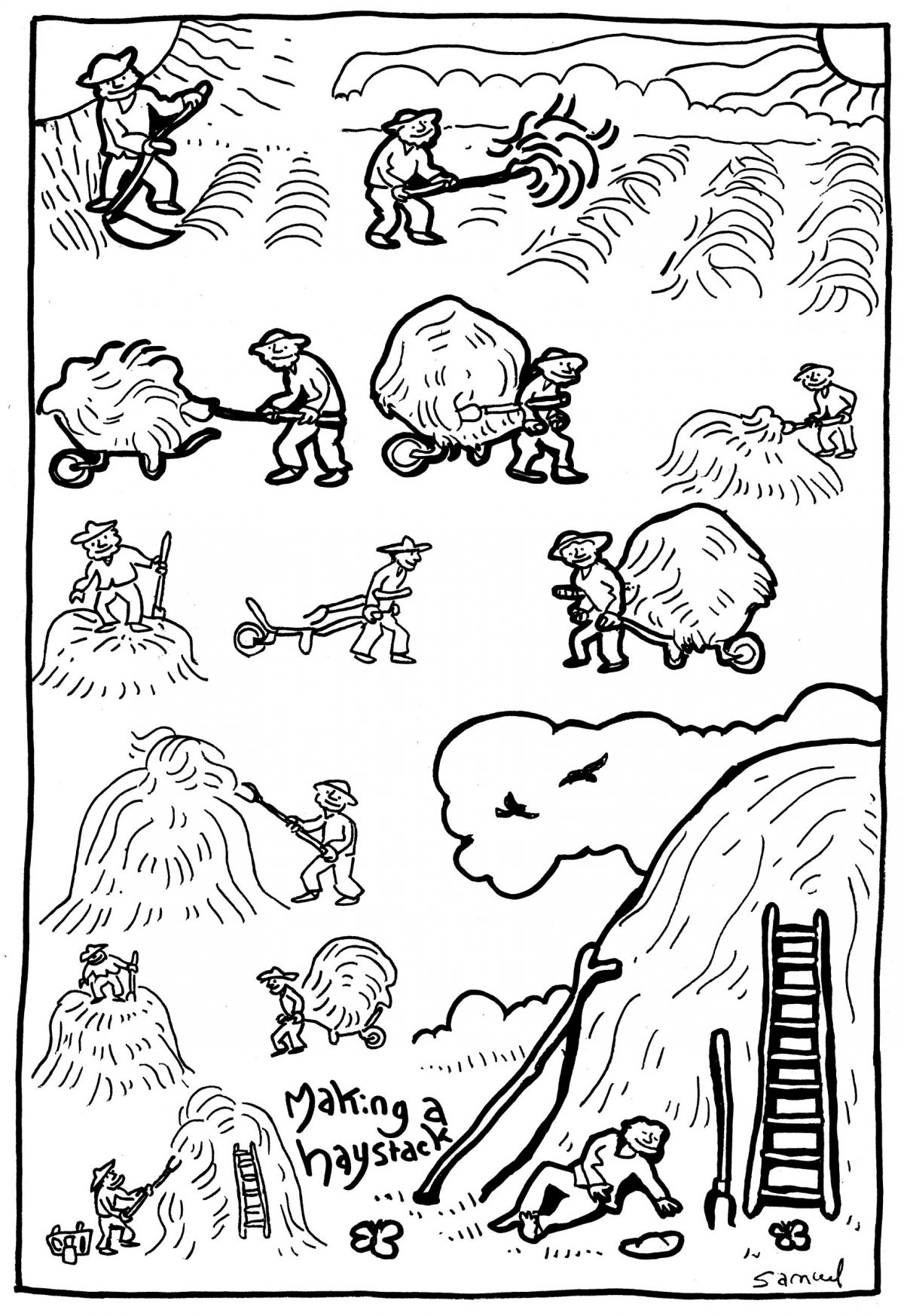
When dealing with livestock, there is also the question of how hay should be stored: if it gets wet or damp, it may start to rot, and become inedible. Big bales of hay can be stored outdoors for a while, but small bales need an indoor storage space. Before the days of baling machines, people were skilled at stacking loose hay in such a way as to prevent water from entering the heap; in areas with high levels of rainfall, hayricks were often thatched with straw.
|
| |
|
" As a general rule, it is a good idea to focus on trying to grow food for oneself before trying to grow enough food to feed animals as well." |
| |
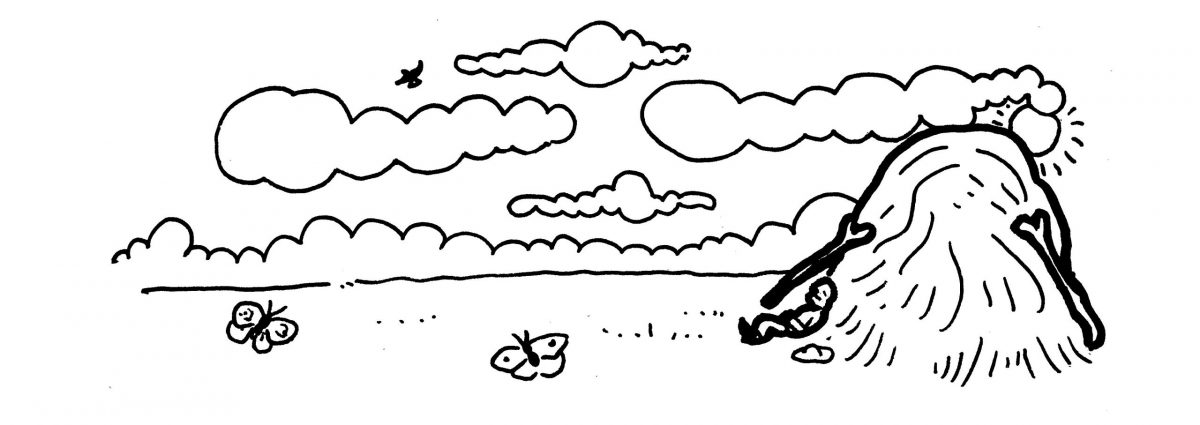
Fortunately for those of us who are relatively new to gardening, most of these haymaking techniques are not relevant to small-scale food production. As a general rule, it is a good idea to focus on trying to grow food for oneself before trying to grow enough food to feed animals as well. In that context, the primary use of hay is then for mulch. Grass can be cut when the days are long and the sun is shining; it can be left to dry on the ground, and turned with a rake or fork every few days, and then simply piled up to make a haystack. It does not matter if this hay contains inedible, or even toxic, plants, because it is not going to be fed to animals. It also does not matter if you fail to dry it properly: you are unlikely to cut enough grass to make a heap big enough for it to generate enough heat to set itself on fire, so the worst that can happen is that it may start to decompose – which may even be to your advantage.
Assuming that you do a reasonably good job you will have a pile of dry vegetable material that will make an excellent mulch to cover the ground later in the year, when the crops have been harvested, or which can be left where it is for one or two years, without it coming to much harm,
One of the factors that has motivated me to use hay in this way is that I don't think that there is any general recognition about what has been done to our once-fertile agricultural lands. In my experience, land that has been subjected to modern farming methods is no longer able to produce usable crops without a large annual dose of fertiliser or manure. When we realised this was the case on our own land, we looked for a way that we could help our soil to heal itself, that did not involve bringing more machinery onto the land, that did not involve buying more products, and that was not too difficult for us to do on our own. Recycling the growth on our grassland through our crop areas has proved to be an effective solution, and small haystacks dotted around our land have become a feature of our garden.
We use a scythe to cut our hay fields, but I like to imagine that one would be able to cut enough material with a sickle to meet one's need for mulch, if one's land was in a normal state of health. Cutting non-cultivated areas once or twice a year with a sickle or scythe, removes the need for mowing and strimming, favours a diversity of plants and animals, and yields a product, which, if a little care is taken with the drying, can easily be preserved until it is needed.
Gareth Lewis
|
| |
|
Feedback & Questions: Distilling Alcohol
Thank you for your latest newsletter. I’ve been distilling for over a decade and we use it for making tinctures and drinking, or to save a wine experiment that wasn’t that tasty. Typically though we’re making cider from the apple trees on our land which we preserve as juice, and some as wine, and some for the still. I hadn’t thought of a walnut tincture … that sounds really yummy.
I share your view and sentiments regarding fiat currency.
Brian Nichols, Nova Scotia, Canada
Lambig vs Calvados
An interesting article! Is there any relationship with Calvados, a favourite of mine.
Wayne Evans, Haute-Vienne, France
Yes, it's the same drink – they call it Lambig in Brittany, and Calvados in Normandy. GL
Digital ID will drive me off the System
Very wise words.
I'm looking to sell my property in the next few years, and to buy an orchard and land with a barn and water, and a small mobile home to avoid council tax.
I plan to plant crops, veg, and have rabbits for meat.
Gold, money, possessions cannot provide security. Digital ID will drive me off the System.
Jenny Wood, UK.
Shifting Straw
Could you describe how you shift mown hay or straw from one field to another location, assuming you do so by hand, and the hay is loose, not in compacted bales? I am about to attempt this task with the oat straw from 12,000 square feet (1,100 square metres) of land; moving it several hundred feet to mulch a different field... perhaps this is a topic you have covered in the past, I'm a relatively recent subscriber. Really enjoying all your posts.
Fred Beddall, Massachusetts, USA
We use wheelbarrows. Wheeling stuff from one place to another is one of our major activities: in the winter we wheel firewood, faggots, and compost, in the summer we wheel hay and straw, and in the autumn we wheel mulch. It is a very interesting subject, and worthy of an article of its own.
|
| |
|
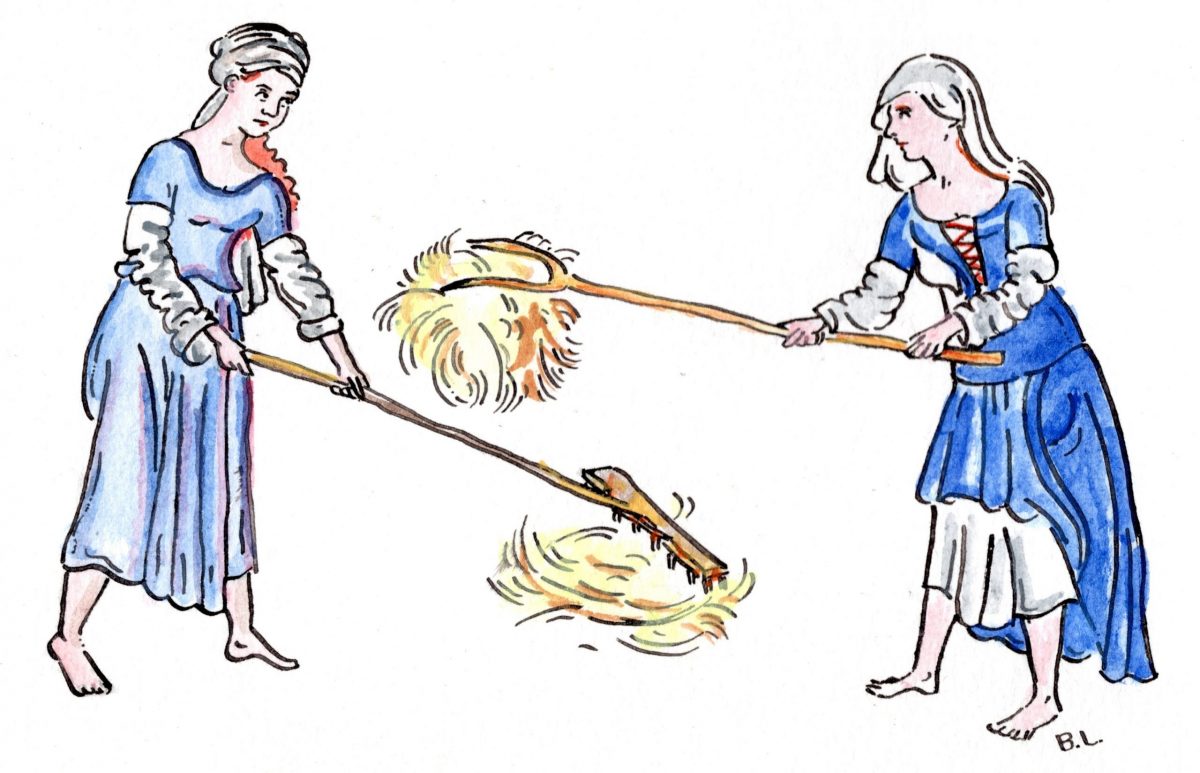
Above: Women making Hay. Drawing based on an illustration in the Très Riches Heures du duc de Berry (a medieval Book of Hours created around 1415). |
| |
|
Feedback always welcome, send to: info@hoe-farming.com |
| |
|