The economic system of a subsistence farm involves production taking place in the fields, and consumption taking place in the farmhouse. The transport requirements of this system are quite simple, and can often be met by carrying something from one place to another.
Water is one of the heaviest and most difficult items to transport, and it was therefore traditional to site houses close to a reliable water source.
The vegetable garden, ideally, would also be close to the water source, as vegetables are the crops that benefit most from being watered from time to time. This results in the vegetable garden being close to the house, and the transport of vegetables not being a problem.
Other crops may be a little further away, but do not present a serious transport problem; bundles of cereals can be carried back to the threshing ground, usually close to the house, with the straw then being on site for any thatching that needs to be done.
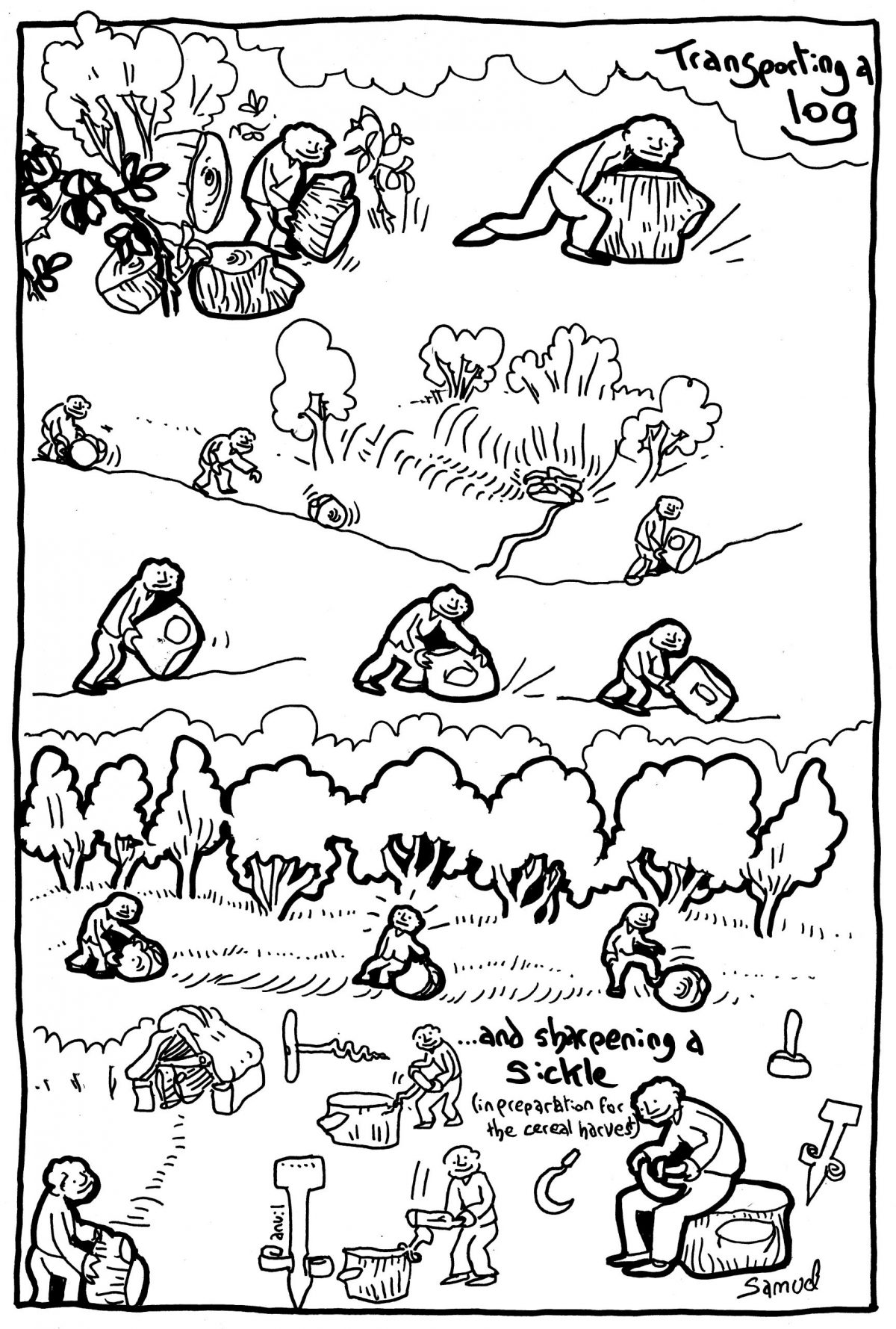
Wood is generally the heaviest material that has to be moved in large quantities over a longer distance. Traditionally, this can also be carried, particularly if the wood is bundled up into faggots after it is cut, and the faggots stacked up to dry in the field. They are then relatively light to carry, as and when they are needed.
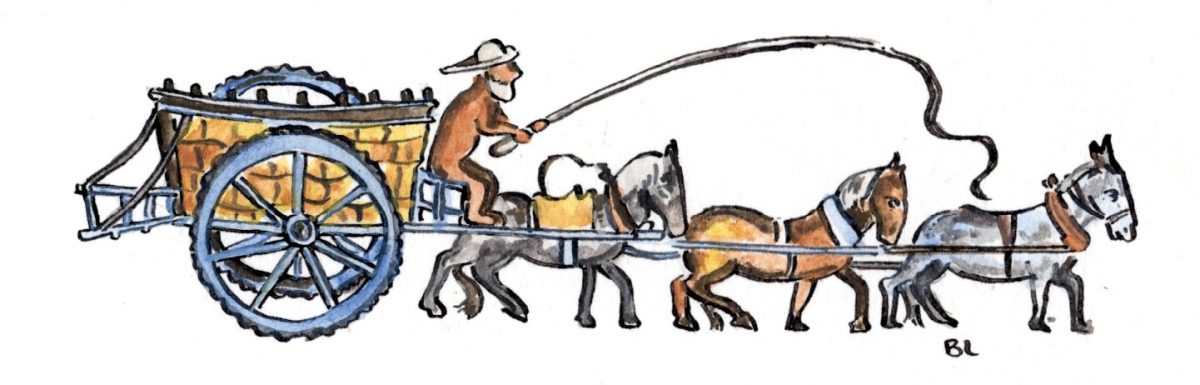
Animals do not need to be transported – they can transport themselves – and it is not worth keeping an animal simply for it to carry things round a small, one or two acre farm, but there is a long history of rural communities keeping animals – horses, donkeys, mules, and llamas, for example – that can be used as beasts of burden to carry surplus produce further afield, such as to a local market town. There is a limit to how much can be carried by an animal, and the distance that it can be made to carry it, and that set a limit on the size to which local towns could grow. This was overcome in the case of towns on large rivers, which could be supplied by boat, giving rise to the ancient city-state civilisations. The Romans took transport a stage further by linking cities together with roads that were suitable for wheeled vehicles, making it possible to transport all manner of goods around their empire.
In modern times, new forms of transport have gone hand in hand with economic development: canals, railways, motorised vehicles, motorways, ocean-going cargo ships, air transport, pipelines, etc. Nowadays, everything is transported away from its site of production to a site where it is transformed, and then transported again to be further transformed, and so on, until it finally reaches the place where it is consumed. Then the process of transporting the waste products away again begins.
|
| |
|
"When some of the wealth is transported away from the farm, towns and cities emerge, and they become centres of power and influence, giving rise to centralised forms of government and hierarchical societies." |
| |
In the old system of everything staying on the farm, each household was a small centre of wealth, with its own store of the essentials of life. This automatically led to a decentralised system of government, with both power and responsibility being evenly distributed across the whole community.
When some of the wealth is transported away from the farm, towns and cities emerge, and they become centres of power and influence, giving rise to the centralised forms of government, and the hierarchical societies that have been common in Europe, and many parts of Asia, throughout recorded history.
This process of centralisation has been taken to an extreme in today's world: everything is transported away from the farm, power is no longer devolved to the local town, or even to a country's capital city, but resides in transnational corporations and institutions that seem to have escaped all form of human control.
Going back to basics, caring for a piece of land, and guarding and recycling its products on site, returns some control to the individual. I have not personally fully embraced the time-honoured system of simply carrying everything I need from one place to another, but my wheelbarrow is in almost constant use, giving me an insight into what life may have been like in simpler times, when technology was less pervasive, and it was possible to keep the produce of one's own labour, on one's own land, for one's own use.
Gareth Lewis
|
| |
|
Feedback & Questions:Hay and Haymaking
Decomposing Hay Could be an Advantage
Thank you for keeping writing about your activities, your findings and sharing your thoughts on so many issues….we always look forward to the newsletter arriving!
One of your thoughts…..decomposing hay could be an advantage….prompts me to share our experiences….my brother, an organic farmer all his life, advised us that the small hay bales we were making on our farm, could be used as a wonderful mulch/compost to prepare the planting spot for our planned orchards. Placing the bales and allowing them to naturally spoil, provides a food earth worms can’t resist…..thus preparing the planting place for the new tree later in the year. Wonderful friable rich soil is created, plus the hay not consumed by the worms mulches the newly planted tree!
Bron and Pete Kirby, Brittany, France
Grass Seeds in the Mulch
Thanks for the article on haymaking. I have recently scythed some grassland at the back of my house and put it in a pile for use, later in the year, as mulch on the vegetable beds. My worry is that the grasses had seed heads – is this a problem? Maybe next year I should scythe earlier, but would hate to waste what I have cut!
Jonathan, Somerset, UK
One question: how about grass seeds in the hay? When you use it as mulch, you run the risk of importing grasses into your vegetable beds, don't you? I'm asking because at my place grass is extremely invasive and dominant, after centuries of animal manure, and I have a hard time keeping it out of my growing areas. I wouldn't like to sow grass seeds myself by way of my mulch ...
Lies Wesseling, Netherlands
So far, we have not had a lot of problems with the grass seeds in our mulch. Grass grows in our winter cereals – we deal with this by smothering it with mulch after the harvest – but grass does not seem to be able to get established in the crops sown in the spring and summer. If the winter is mild, grass does germinate and grow in the mulch; we deal with that by turning the mulch (sometimes twice over the course of the winter), which has proven to be very effective.
We used to have grass in our vegetable beds, growing in from the paths. In the end, we gave up growing vegetables in beds, and have gone back to having them in long rows, with no permanent paths.
I don't want to be responsible for giving advice that causes unnecessary work for people, but we have been using hay as mulch for over ten years, and have been very pleased with it as a weed suppressant and as a source of nutrients. I am sure that it contains grass seeds, but grass is not one of the weeds that causes us the most difficulties in our crop areas. GL
|
| |
|
Above: Horse-Drawn Cart. Based on a medieval illustration. |
| |
|
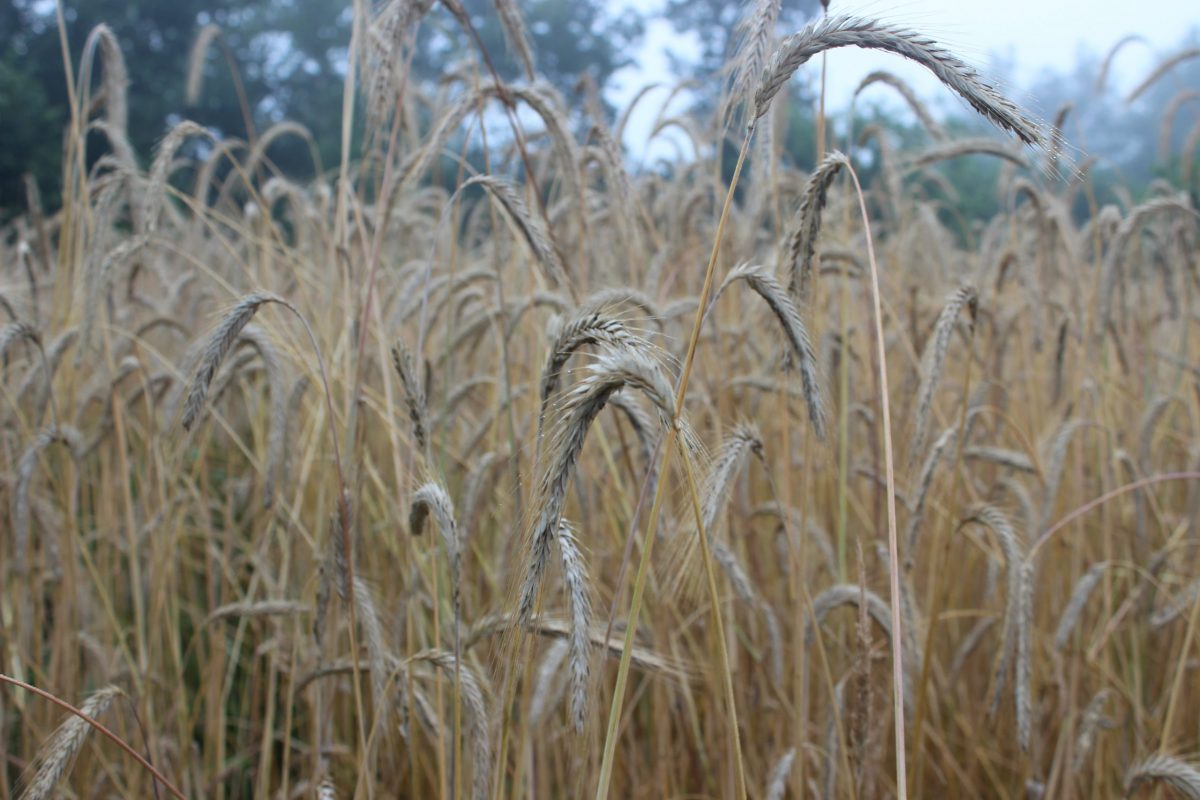
Cereal harvest. We'll be starting to harvest our winter sown rye and wheat this week. When the plants look golden (rather than green) and the grains become slightly chewy, it is OK to start harvesting. The stalks are tied into bundles and left to dry in the field for a further one, two or even three weeks. |
| |
|
Feedback always welcome, send to: info@hoe-farming.com |
| |
|