Amongst other basic necessities, such as food, water, clothing, and fuel, most people would count the need for having a roof over their head as being of supreme importance to a human being. It is not surprising, therefore, that housing is included in the United Nations charter of human rights as something to which everyone is entitled – but that leads to the question, 'Who provides the housing, and how is it paid for?'.
In the distant past, this question had a simple answer: the land provided the building materials, you built the house yourself, and there was not anything that had to be paid for.
The most challenging part of any building project is the roof – if it lets in water, the building becomes useless – and, nowadays, it is tempting to turn to a manufactured product, such as plastic, or metal sheeting, to get a water-tight roof on a building that in other respects might be made of locally-sourced, sustainable materials. In most places, however, there was once a much simpler solution: thatch.
If you grow enough cereals to feed yourself, then, at this time of year, you will also have a big pile of straw; if you are growing traditional varieties, particularly of rye, this straw will be long, strong, and ideal for use as a thatching material. A single family may not produce enough straw in a single year to thatch a whole house, not even a small one, but, in a village, people would have been able to pool their straw crops to make a new roof whenever one was needed.
Thatching would not have been a specialist craft in the days when everyone made their own thatched roofs for themselves, and people adapted their techniques to suit the materials that they had available. Ironically, it seems that this sort of local thatching knowledge started to disappear from Western Europe around the time that demand for cereals to feed people in the towns increased. Hand-threshing proved to be a bottleneck in commercial cereal farming, and this spurred on the invention of mechanical threshing machines (precursors of today's combine harvesters), which rendered the straw unusable for thatch, depriving people in the countryside of their roofing material, and contributing to a dramatic increase in rural poverty.
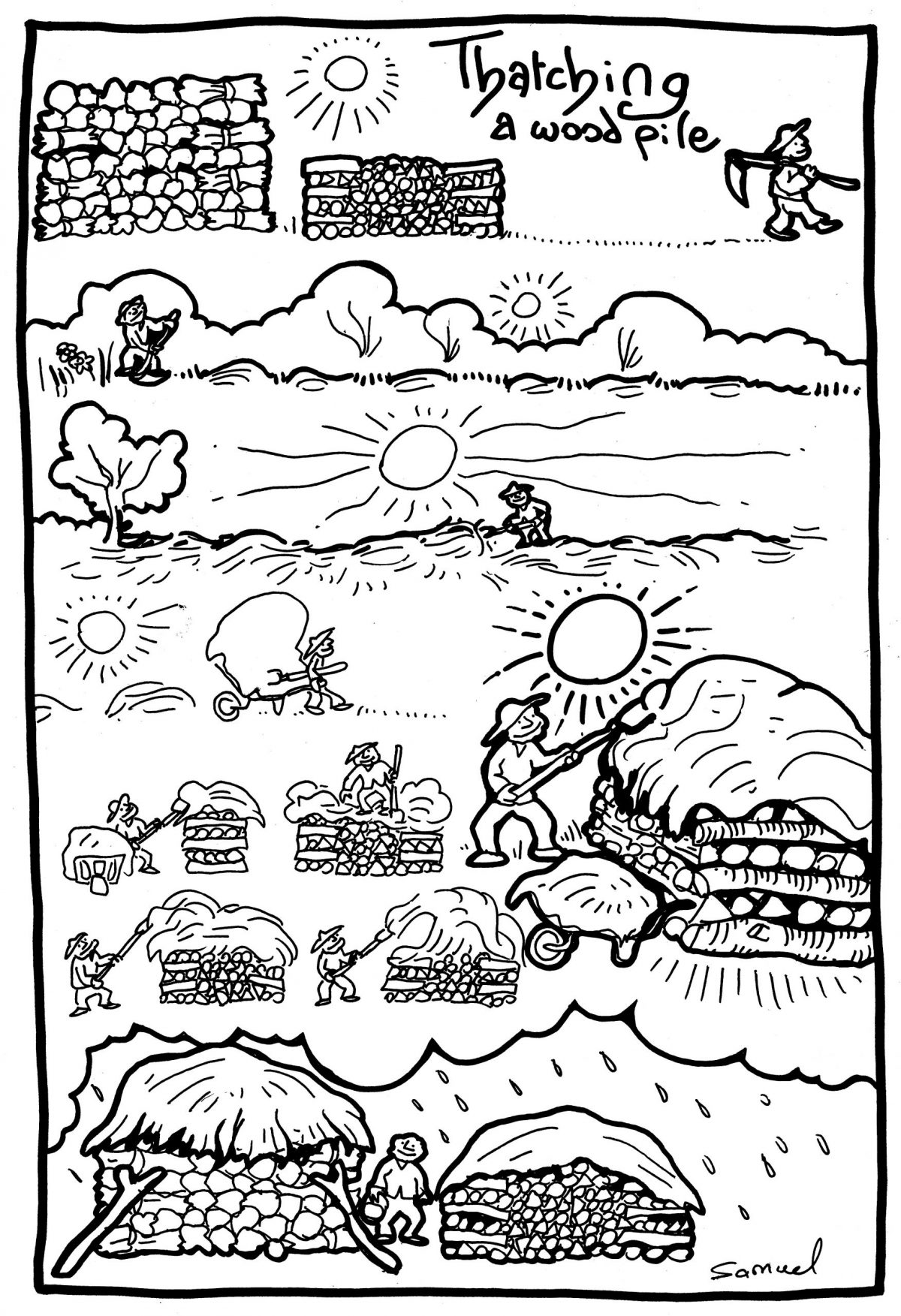
In our own case, it took us a couple of years of hand-threshing our rye before we realised what a valuable part of the crop the straw actually was; if it is left to stand outdoors in the rain, it soon becomes unusable, and has to be returned to the field as a mulch, but if you have a project in mind, it can go straight from the threshing ground onto a roof, where it will remain intact for many years.
Our own thatching skills were non-existent when we started, and we have still not got to the point where we would be happy to thatch a house, but we have a thatched shed in which we stock wood and keep our tools, plus various other thatched shelters around the garden. The main challenges are to fix the straw in place so that, on the one hand, it does not slip down the roof, and, on the other hand, it does not get blown off in a strong wind, and to work out a system for the ridge of the roof. Repairs can be made, and extra layers added, each year, using straw from the new crop; and once you start to get an understanding of the material, research into traditional thatching methods starts to make more sense, and you can refine your techniques.
Although housing is only one item on the long list of basic human needs included in the charter of human rights, it is perhaps the one that has been monetised by our current economic system more than any other. Property has had a price put on it, people are encouraged to take on life-long debts to pay for it, and the housing market is propped up by a complex system of planning regulations, often designed to stop people building new homes in the countryside. Part of the justification for this is that buildings made from modern materials are non-biodegradable, and non-recyclable, and should therefore be kept away from nature. But, logically, if we really do respect people's basic human rights, we should still be giving them the option to live on a bit of land without having to take on a lot of debt, to grow a crop of cereals for themselves, and to live in a little cottage that they can build themselves, thatched with their own straw.
Gareth Lewis