|
One piece of advice that I would give to anyone moving into a new property is to keep the amount of earth moving done with a mechanical digging machine down to the absolute minimum.
In many ways, digging machines are one of the key inventions of modern times, facilitating both urban development, and the remodelling of the countryside to suit the needs of modern farming.
In our part of the world, the use of these machines has been almost ubiquitous for the past half century, and one is unlikely to find a property that has fully escaped their attention.
Our own property is in an area that is renowned for being relatively isolated and undeveloped (central Brittany), but when we moved in, in the 1990s, there were already signs of previous earth-moving activities.
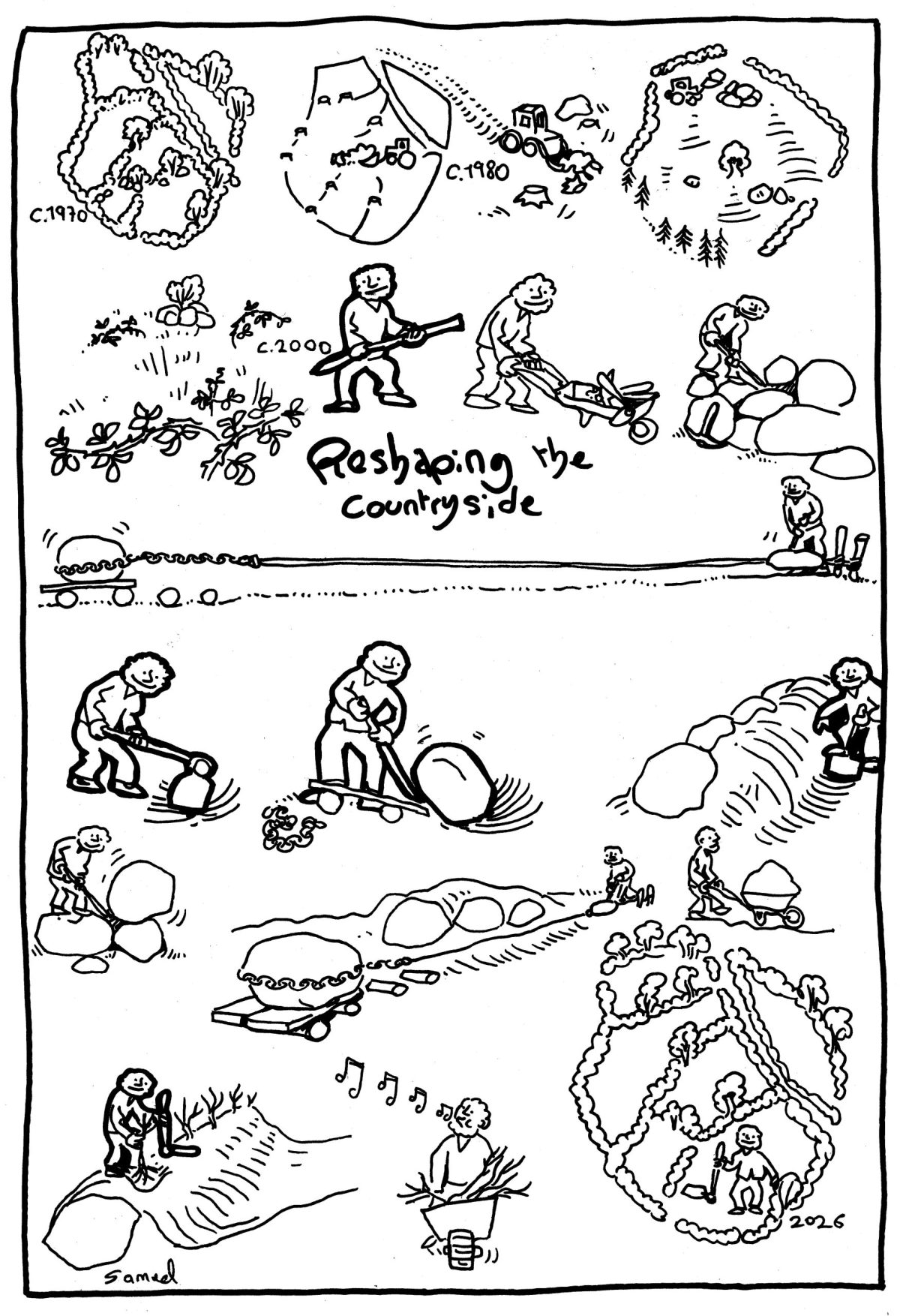
In the 1960s, the track that ran through our hamlet was upgraded to make it suitable for motor vehicles. The work involved widening the track, removing banks, and piling earth into surrounding fields. Around the same time, bulldozers were used to take down banks and level fields to make them easier to work with combine harvesters. More recently, a new farm track was built nearby, and the previous owner of one of our fields agreed to have the 'topsoil' dumped on his land in an attempt to level off a sloping field.
It has been interesting to see how things have evolved with all these earthworks over the years. The topsoil used to level off the field was the most obvious problem, perhaps because it was the most recent work that had been done. Initially, we thought that cutting it once a year with a scythe would allow grasses to become established, but brambles, nettles, bracken, and thistles continued to be its main plants, and it tended to dry out more than the surrounding land. Using a pick axe, a shovel, and a wheelbarrow, we started to dig it out and add the earth to nearby banks. It was a job that we would go back to for a few weeks each year, and we gradually reclaimed the original shape of the field. The ground under the mound recovered remarkably quickly, and soon started to produce a normal crop of grass, without needing to be seeded, or worked over.
Moving the mound of earth one shovel-full at a time taught me a lot about the work done by mechanical diggers. Although it may have been labelled as topsoil, the mound was in fact a mixture of topsoil, subsoil, lumps of clay, and rocks. Even after twenty years, it was still only loosely packed together, and had no structure.
This has given me an insight into what may be wrong with other areas of ground that behave oddly. Some may be piles of earth left over from the road building, and others may have had all the topsoil scraped off them during the field-levelling operations.
The initial impression that one gets when one sees a mechanical digger at work is that, despite all the noise, it is very efficient at what it is designed to do: it can scrape off topsoil into a pile, move large quantities of earth from one place to another, mould the ground into any shape that you want, and replace the topsoil in those places where it is needed. This works fine if the ultimate aim of the earth moving is a building or infrastructure project that involves the ground being concreted or tarmacked over, but it does not work so well on gardens or agricultural land.
Even though the top layer of soil may have been put to one side, and then spread on the surface when the job is completed, this does not mean that the topsoil has been preserved. Topsoil is the interface between the above-ground world on the one hand, and the below-ground world on the other. Even if it were possible to roll it up, and then roll it out intact on the re-moulded ground, it would still find it difficult to fulfil its role, because it would not have a relationship with the disturbed ground upon which it was sitting. Of course, it is not possible to roll up topsoil, and the material applied after an earth-moving operation is in reality an inert mixture of soil particles, largely devoid of life. In this respect, work done by mechanical diggers is more damaging to the soil than work done by modern tractors and ploughs, which just disturb the surface layers of the earth.
My experience is, therefore, that when it comes to reshaping the garden, and any area in which you wish to grow plants, it is better to work with a shovel and a wheelbarrow than with a mechanical digger. In the short term, progress may appear to be slow, but, in the long term, areas moulded by hand will prosper, while plants continue to struggle in areas moulded by machines.
Gareth Lewis |