Many modern gardening books have a tendency to create unrealistic expectations. It seems to be a feature of the publishing industry that, when it produces a new book, it seeks to convince people (especially people with no previous gardening experience) that the author has discovered a new way to produce crops that is better than anything that has gone before. Readers may be told, for example, that bigger and better crops can be produced without the need for any artificial fertilisers, animal products, or manure, and that no digging or working of the soil is required. Whilst this might be true for the authors themselves, who may be very experienced gardeners, it does not follow that the techniques described will work for an inexperienced gardener working on a new plot.
Overall, this sort of literature gives the impression that gardening and crop production has been subject to the same arc of progress over the past few hundred years that has revolutionised so many aspects of life, from metal working to medical science, and from telecommunications to transport. However, on a closer examination, in the case of gardening, this premise of progress is illogical. It is undoubtedly true that the twentieth century saw a dramatic rise in agricultural yields. These were due to the profligate use of inorganic fertilisers, insecticides, fungicides, herbicides, other chemicals, and big machines. If one regards these as having been a step in the wrong direction, then they cannot also represent progress.
Furthermore, the near-universal adoption of these techniques has led to the steady erosion and loss of traditional gardening knowledge, that may have been built up and passed on from generation to generation over the course of centuries, or even millennia.
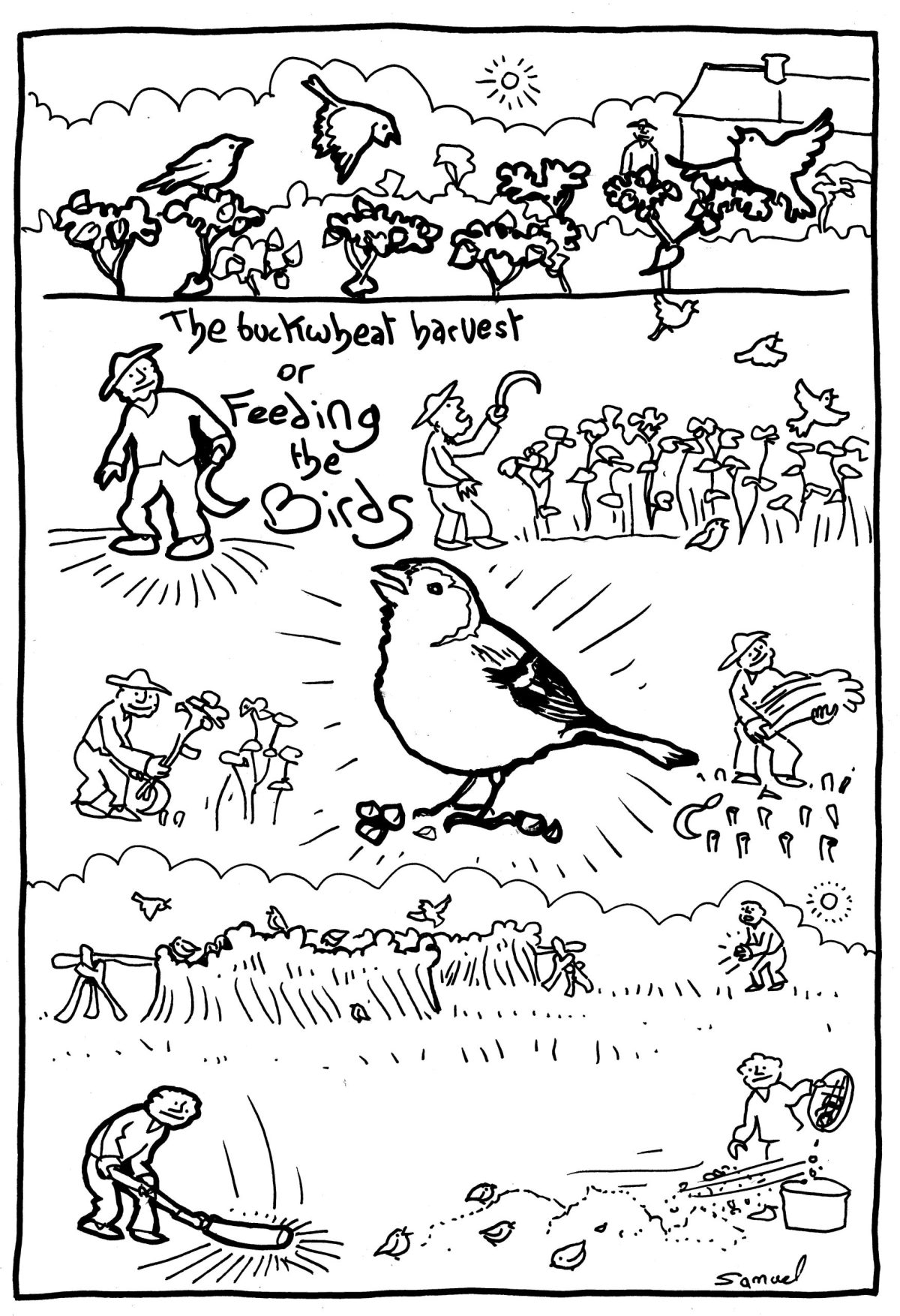
I am constantly reminded of this fact in my attempts to grow buckwheat. Archaeological evidence suggests that it was grown in Brittany in pre-historical times; its use was suppressed in the Roman era, but it became popular again in the Middle Ages, to the extent that Breton cuisine became closely identified with buckwheat recipes. Its popularity appears to have been linked to the fact that it was not subject to the same feudal taxes as other grains, and it became the quintessential crop of the small-scale Breton subsistence farmer. Its use died out almost completely during the post-war modernisation of French farming, which more or less brought about the end of subsistence farming in France. A revival of Breton culture just a few decades later led to a demand for locally-grown buckwheat from newly-opened crêperies, and some farmers started to grow it again – but using the new techniques of tractors, big fields, and combine harvesters.
Convinced that buckwheat is a traditional crop in our area, we have been growing it every year for about fifteen years. There have been years when the crop has been good, but there have been more years when the crop has been poor, and some years when there has been no crop at all. Elderly neighbours are pleased to see buckwheat growing in small fields again, and are keen to offer help and advice, but memories of their pre-war, or immediately post-war childhoods are necessarily vague, and they do not know exactly what their parents and grandparents were doing to consistently get a good crop – or even if they were getting a consistently good crop.
Buckwheat is good for the soil, and plays a useful role in our crop rotation, so we will continue to grow it, and will continue to experiment with different planting times, and different ways to prepare the ground, and will continue to ask friends and neighbours for tips and advice, but we also have to acknowledge that, with just fifteen years of experience, we are still only scratching the surface of the knowledge that may once have existed about the cultivation of this one simple crop.
This illustrates that it would be more helpful if the gardening literature stressed the importance of resetting one's expectations of what one might achieve in one's early years of gardening. Managing to grow anything at all is a triumph, and is something to be proud of. Even the complete failure of a crop should not be seen as a personal failure, and can be turned into a success if you are able to analyse what you did right, and what you did wrong, and to put what you have learned into practice the following year. One should not even want to match the inflated yields obtained by using chemicals and agricultural inputs, and it may not be realistic to expect to be able to match the yields obtained by gardeners in the pre-industrial age – but if one starts with a set of realistic expectations, one can still be proud of what one achieves.