Here in Brittany, we are having a bumper chestnut year. This summer set new records for both heat and dryness, which seems to have suited out chestnut trees perfectly. It is generally believed that chestnut trees are not native to our region, but were introduced by the Romans around two thousand years ago. European chestnut trees are most happy in the Mediterranean region; and we are towards the northern limit of their range – they will grow further north, but will not set seed so often.
Chestnuts are unusual in that they can play the same role as cereals in the diet (they do not contain a high level of oil, like walnuts, but are rich in carbohydrates, like wheat and rye). In some more southerly parts of France, and in other Mediterranean countries, chestnuts have traditionally been a staple food, particularly in mountainous regions where the trees grow well, but the terrain is too steep for cultivation. Chestnuts, however, are not as easy to store as cereals – they do not dry out naturally. In Nature, they start to germinate shortly after coming into contact with the ground, and then the emerging seedling goes into a dormant phase over winter; when stored, they only last a few months before going off. People who relied upon them as a staple food, therefore, had to dry them out, usually in specially-designed buildings in which the chestnuts could be laid out, and a fire kept burning. The dried-out chestnuts could then be ground into flour as and when it was needed, and used to make bread and cakes. Here, we don't normally have enough chestnuts to make it worthwhile to go to that much trouble, and are content if we have enough chestnuts for roasting.
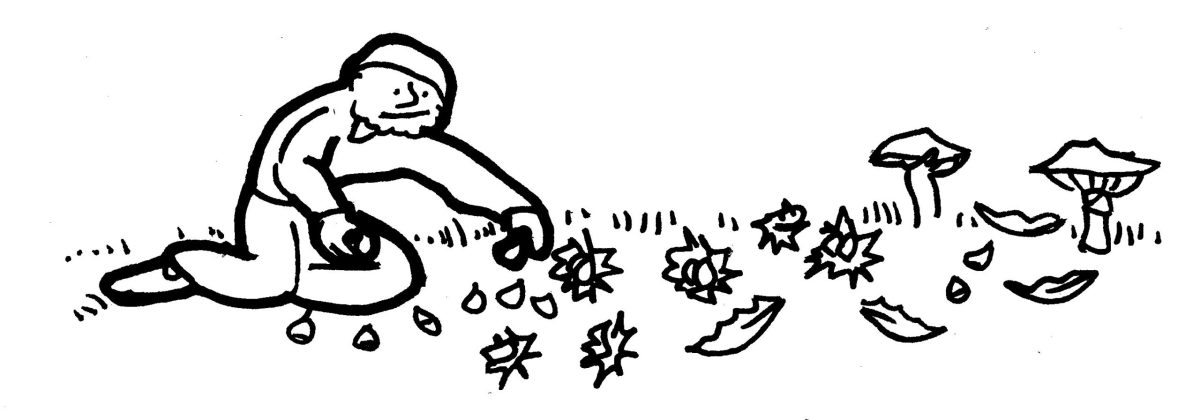
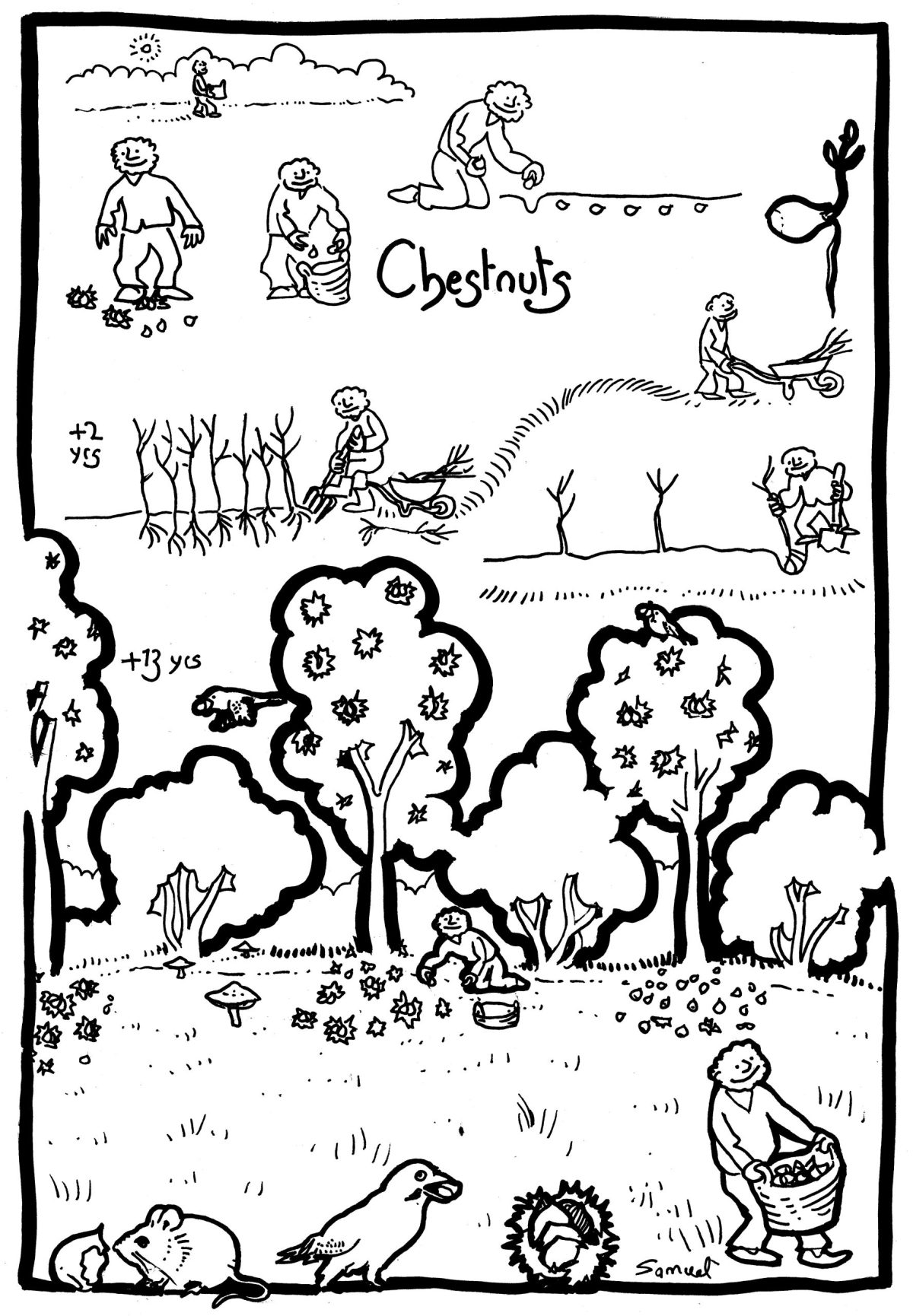
When we first arrived in Brittany, we did not have any chestnut trees on out land, and, at this time of year, we went foraging beside the road, or on neighbours' farmland, picking up nuts that would otherwise have been left on the ground. The farms in our area had become too big for the farmer to collect all the nuts on their land, and, in practice, they were generally too busy to pick any of them at all. Since then, we have planted quite a few chestnut trees when making hedgerows and banks, and have carefully tended them from one year to the next – protecting them from being eaten by deer and hare, cutting the brambles that want to smother them, and cutting off side branches. Most of them were grown from seed (rather than being grafted) and we are now starting to see which of them produce well-formed nuts of a good size. When we coppice a bank, we simply prune the trees that give good nuts, and coppice the others – chestnut wood has many uses on the farm.
This experience has made me realise that the big chestnut trees that we foraged around when we first arrived, were not there by accident. Back in the days when there were a lot more people living in the Breton countryside, and each farm was only one or two hectares in size, each of these trees must have been given the same care and attention that we were now giving our own trees. Each must have belonged to a different family, who had planted them and cared for them, with a view to having chestnuts for themselves, but also for anyone that took over their farm in the future.
The same is probably even more true for the chestnut forests further south: when chestnuts are your staple food, it becomes essential that you should know which trees you can forage around, and which ones your neighbours can forage around, and who is responsible for ensuring a new chestnut tree grows to replace one that gets too old, and ensures that the replacement has good nuts.
The same must have applied to the vast forests of American Chestnut trees that covered the North East of the United States before the arrival of Europeans, and the accidental introduction of the fungus that causes chestnut blight (to which the American trees had no resistance). Little seems to be known about how people living in the forests organised themselves in terms of land distribution, or how they preserved and used the nuts.
Subsistence farms can take many forms ranging from an area which might look like a virgin forest, but which is in fact a carefully-managed landscape in which each tree has been selected and cared for by many generations of people, to an area that might simply look like a network of crop-producing fields, but which also contains equally-important trees and managed environments that can be foraged at different times of the year. The idea of foraging in the wild may be something of a misconception.