Managing the Vegetable Garden
The vegetable garden has an inherent tendency to take up a disproportionate amount of one's time; its produce is more of a luxury than being essential to life, and yet one can easily find oneself spending countless hours tending sensitive plants in the vegetable garden, whilst forgetting about cereals and fuel for the fire, which in other times really were a matter of life and death.
When planting in the spring, it is good to bear in mind that crops such as carrots, beetroot, spinach, parsnips, onions, and cabbages require very little summer maintenance, but others, such as tomatoes, courgettes, peppers, peas, sweet corn, and green beans have to be picked regularly, and immediately eaten or preserved in some way, or else they will go to waste. Experience has taught us to limit the amount that we plant of these crops, so that we are not overwhelmed by picking and pickling produce just when the weather is hottest, and one is most in need of a rest. We do, however, make an exception for green beans.
Green Beans
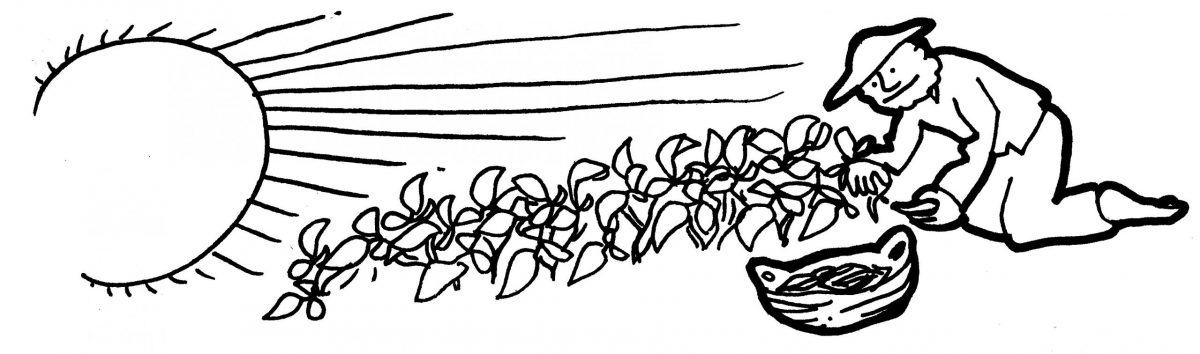
Green beans, otherwise known as French beans, string beans, or snap beans, are grown for their pods, which are cooked as a fresh vegetable, rather than for the beans themselves. If the pods are picked regularly, when they are still small, the plants keep flowering and producing more pods, extending the picking season. It is not clear exactly where they come from originally, but it is from somewhere in Central or South America. The plants are frost-sensitive and need a warm soil in which to germinate, and are therefore one of the last things to be planted in the vegetable garden in the spring. Most people now grow dwarf, non-climbing varieties that do not need a trellis to support them. The plants grow, and mature, quickly, and you have to start picking the beans about eight weeks after planting.
Lacto Fermentation
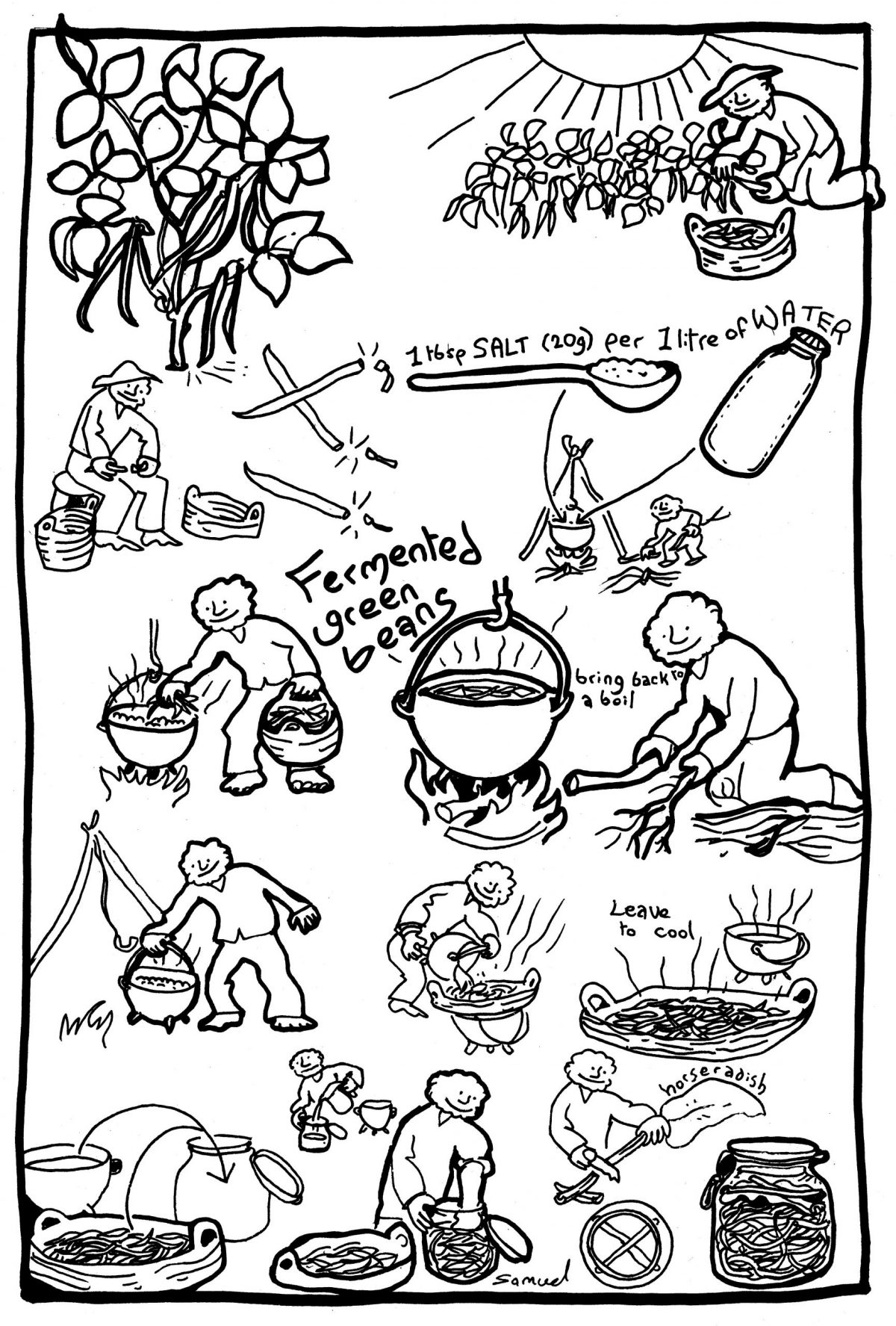
Lacto fermentation is a relatively low-tech solution to preserving green beans. It makes use of the same fermentation process as used to make sauerkraut, but, whereas sauerkraut involves grating the cabbage, or chopping it very fine, and packing it with salt, the green beans are fermented in brine. The aim is to create an oxygen-free environment in which naturally-occurring bacteria partially digest the beans, producing lactic acid as a byproduct. When the concentration of lactic acid reaches a certain level, the bacterial activity stops, and the beans remain in good condition for months, or years. The salt seems to aid the fermentation process, and helps to keep the beans crisp. (Alternative preservation techniques that involve sterilising the beans tend to make them go soft, which makes them less appealing.) Non-iodised, pure salt should be used.
The technological part of the process is the glass jars in which the bean are packed. Kilner-type jars are the most-commonly used. Kilner jars were invented in the UK in the mid 1800s. They have a metal clip and a rubber seal. Lacto fermentation takes place in two phases; the first phase simply involves all the oxygen in the jar (in the beans, in the brine, and in the air space above the brine) being used up. This results in carbon dioxide being produced, causing pressure to build up in the jar; the design of the Kilner jar is such that it allows this pressure to be released through the seal, whilst not allowing air to enter back into the jar. In the absence of oxygen, the second, lactic acid producing, phase can then take place. The original Kilner company went out of business some time ago, but Kilner-type jars are still produced, and are widely available; they are not very expensive, and can be re-used. In France, 'Le Parfait' is the brand that dominates the market.
Lacto fermentation is a natural process, making use of microorganisms that one would normally expect to find in a healthy garden. It works best with freshly-picked produce, grown in a chemical-free environment. It may take a little trial and error before you get it to work, so it is still a good idea to start off growing only a small row of green beans at first – just enough to supply the kitchen, plus a small surplus for one or two jars of beans. Production can then be built up if you develop a taste for salty green bean pickle.
Gareth Lewis
|
| |
|
Feedback & Questions: A Roof Over One's Head
Re-Thatching
I just wanted to let you know how much I enjoy all the articles. I live in a small village in Wiltshire and recently four cottages have been re-thatched. Three had new straw added/patched and new ridges woven, and the fourth chose reed, which was cheaper as a material but required everything to be stripped as, apparently, you can't just add an extra layer.
I look forward to reading the email blogs, and was wondering how your crops are coping with the increasingly hot weather? Are you changing planting/sowing times?
Louise McIntyre, Wiltshire, UK
The truth is that even though we have been growing some crops, like potatoes, in the same garden for over thirty years, I still, essentially, feel like a gardening novice. Each year is different, there is never a year when all the crops work, and one is always left trying to work out why one crop did well, and another didn't, and then making adjustments for the following year.
So far, given the extreme weather, the garden has done surprisingly well this year; we have harvested good crops of rye and yellow peas, and the potatoes have done well. If it does not rain soon, things will be difficult in the vegetable garden.
I am planning to write an article on global warming, but it is a complicated subject. GL
Wooden Shingles
I enjoyed the newsletter about roofing. I live in New England in the USA, and here there is another form of self-sufficient roofing available besides thatch: wooden shingles. Today in the US, they are only made from cedar, but traditionally they were made from pine or spruce as well. In France, chestnut is a traditional roofing material that lasts a long time. Split shingles (not sawn on the side facing up) shed water very well and can last a long time. These can be made at home with a few simple tools.
Thank you, and good strength for your farming endeavors!
Taylor Carr, Vermont, USA
|
| |
|
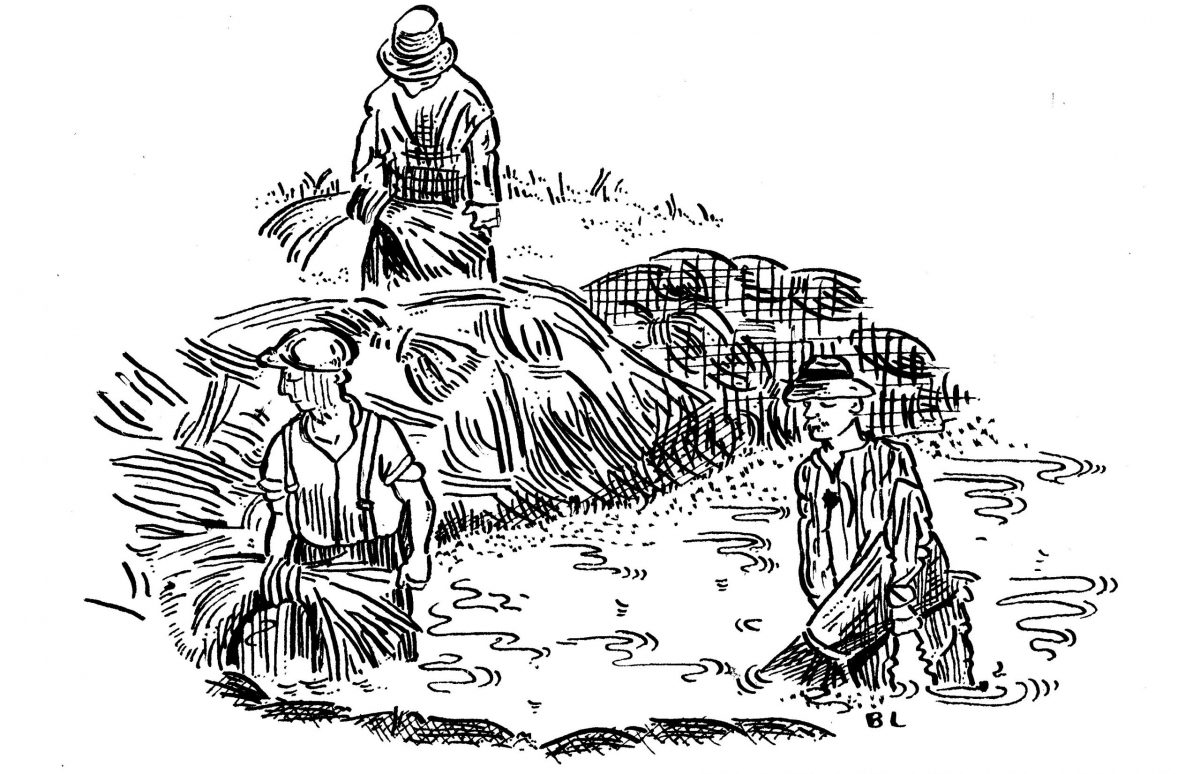
Above: Taking flax out of the water where it has been retting. Drawing copied from an old photograph, taken in Northern Ireland, probably in the 1930's.
This process, which usually takes between ten days to two weeks, partially rots the stems, and the precious outer fibres become detached from the inner stalks. |
| |
|
Feedback always welcome, send to: info@hoe-farming.com |
| |
|