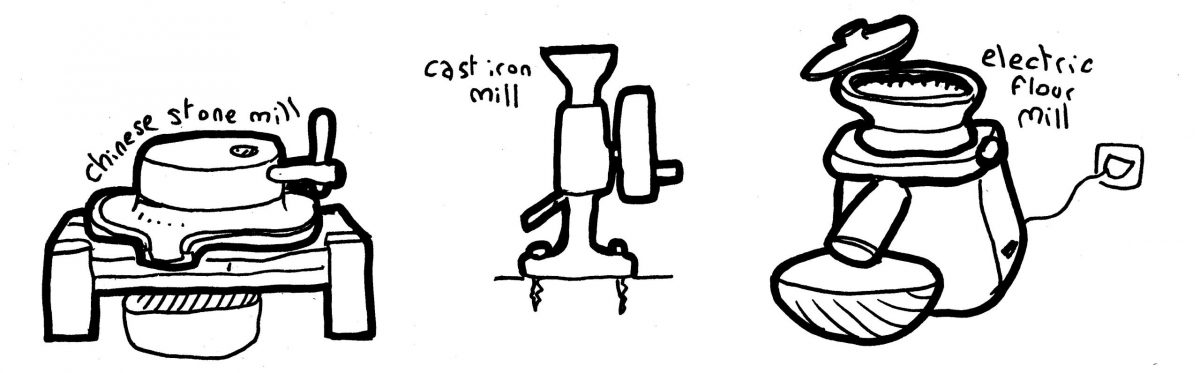
When we started growing cereals for home consumption, over fifteen years ago, I assumed that the main challenge would be to get a crop; I had no idea that milling the grain was a complicated process in its own right. In the event, we were quite lucky: after a few unsuccessful years of trying to grow wheat, we settled on growing rye, and we bought a small, electric Austrian mill that was for sale in our local wholefood store. Although the mill is small, and sits on a kitchen work surface, in a sense, it represents a culmination of many years of evolution in the technology of milling grain. It has two small grindstones – the top one is held firmly in place, but can be lifted up and down to adjust the space between the stones, and the lower one is driven by an electric motor. With the space between the stones set to the minimum, the mill has been able to grind our rye grains into a flour that we use to make wholemeal rye bread. Rye is a softer grain than wheat, and we have probably been fortunate that this mill produces flour rather than becoming clogged up.
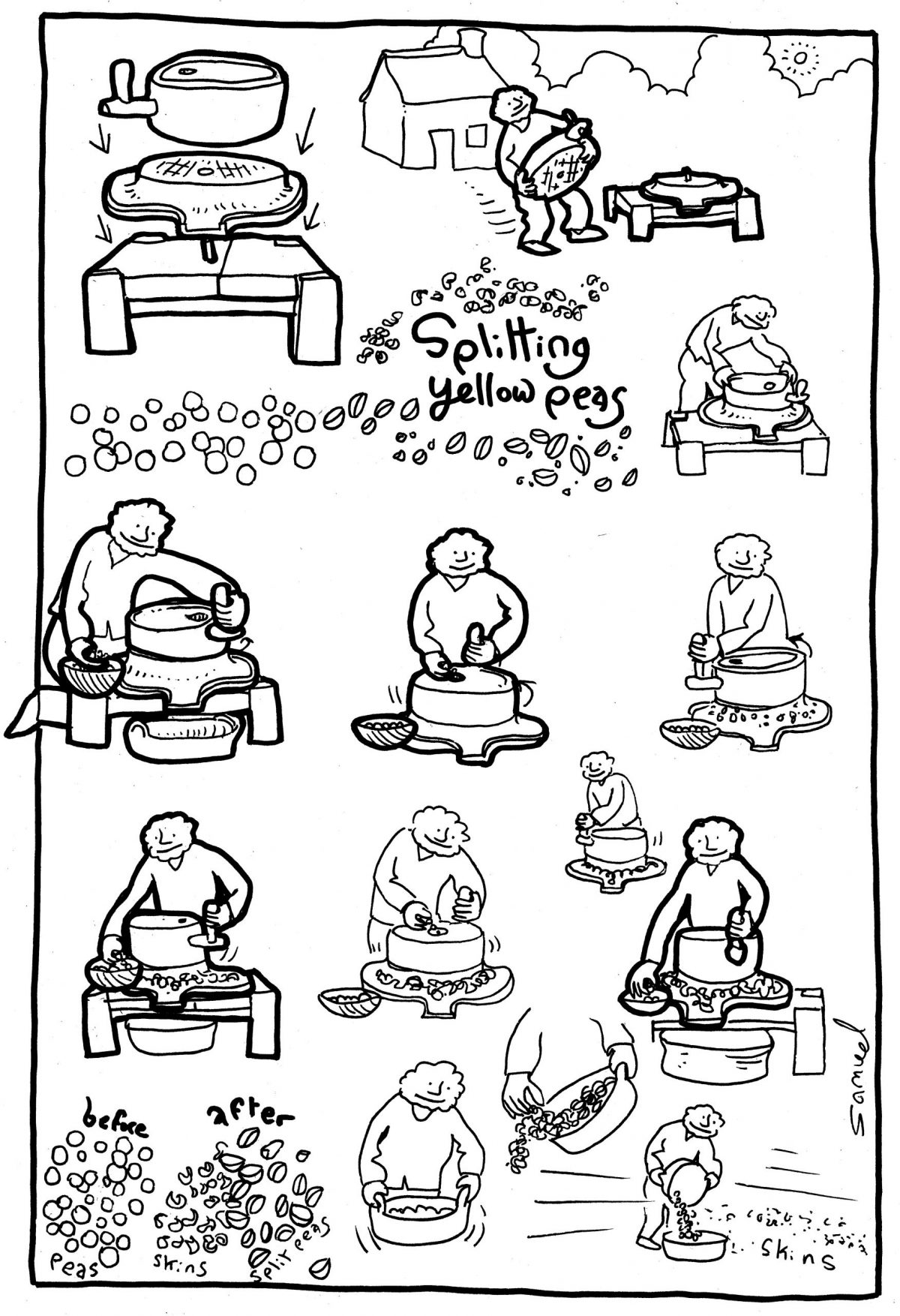
However, we would like to reduce our dependence on electricity, and would be happier if we had a hand-powered mill, that we could at least use as a backup. According to the literature, people ground their grain between two stones for thousands of years before more complex mills were invented. Initially, this was done with a large smooth 'saddle' stone on the ground, and a small grinding stone held in the hand. More recently, perhaps three thousand years ago, the technique was refined, and two circular stones were used, one on top of the other; the top stone had a hole in it, through which grain could be fed, and a handle, so that it could be turned round and round. These hand-powered mills are known as 'querns', and modern versions are still in use in many parts of the world today. It turned out to be remarkably difficult to procure a quern; in the end we imported one direct from China. We have found that the grain has to be passed through it several times before it becomes a fine flour. If we had to rely upon it, we would either have to change our bread recipe, or spend a lot more time milling. Our quern is, however, very good at splitting peas, which is, perhaps, closer to the task for which it was designed.
Water-powered mills are thought to have been introduced into Europe by the Romans, and they then became a major part of life in the Middle Ages. They took milling into a more technological realm, with larger millstones, complex gearing, and a mechanism for setting the space between the stones. In theory, this should have made life easier for everyone, but it appears that, in practice, people preferred to continue hand-milling flour for their own personal use, rather than pay the miller to grind it for them. Feudal lords imposed taxes on the grain processed in the mills, and there are numerous accounts of their agents going from house to house, smashing up people's querns, so that everyone was obliged to use the lord's mill.
Part of the reason why hand-milling remained popular may have been that it allowed people to grind their grain as and when they needed it, so that they always had access to fresh wholemeal flour. The millers, meanwhile developed techniques for sieving out the bran and the germ when milling wheat, to produce white flour, which was easier to store and transport.
White bread became associated with town life, and the upper classes, which eventually led to it being regarded as a luxury product, even though it was less nutritious than traditional country fare.
When wheat production started to boom in the 1800s, the milling industry kept pace. Enormous mills were constructed with the traditional grindstones being replaced with steel rollers driven by steam engines. The grain was cleaned and sorted by a battery of special machines, and then passed through several sets of rollers, each pair carefully calibrated to be slightly closer together than the ones before; at each stage, fine white flour was extracted by sieving. The resulting product was made into breads, biscuits, cakes, and pastries, and marketed to the rapidly-growing urban populations of Europe and America as being the equivalent of the dainties enjoyed by the aristocrats in previous times.
To me, this was a step in the wrong direction, societies that have retained the tradition of home milling have been more able to supply their populations with health-giving wholemeal foods than those that have developed mass-milling techniques. I am still on the lookout for a small, efficient, hand-powered grain mill.
Gareth Lewis