The average large supermarket claims to have around thirty thousand different product lines, most of them one sort of food or another. This abundance of choice gives the impression that the modern, industrial society has succeeded in overcoming the restraints imposed by the availability of food that have previously determined so many aspects of human life.
There are various ways in which this is misleading; firstly, it is rarely explained to us that there is nearly always a trade off between choice and quality – and what the consequences of that trade off might be. It is not possible to get thirty thousand products into a single shop, and for them all to be freshly picked, or freshly baked, or freshly caught. In one's own garden, on any particular day, the choice might be much more limited, but the produce will be fresh.
Secondly, whilst industrial processes may be fine for making some things, such as cars or computers, there is no reason to believe that food produced on an assembly line will ever be as good as food produced in a home kitchen.
Thirdly, the abundance of choice is, to a certain extent, an illusion. Over half the land under cultivation in the world is used for growing cereals – mainly maize, wheat, and rice – and, logically, the same proportion of food sold in the supermarket from cereals, in one form or another.
The reason why cereals play such a large part in the human diet today, is because they always have done – at least since the beginning of agriculture, and probably before, when people living by hunting and gathering collected the seeds of wild grasses. Cereal seeds are a complete food, providing all the carbohydrate, protein, and minerals that people need, and most of the vitamins; they also store well, so that they provide nourishment over the winter months, and, crucially, reserve stocks can be eaten in those years when all else fails.
Thus, the type of cereals that can be grown in any particular area has always had a disproportionate effect upon the local cuisine, and the local culture. In Europe, the more northerly parts of Asia, north Africa, and much of the Middle East, wheat, rye, and barley are the main cereals that people were able to grow, and, up until recently, life has revolved around bread.
The type of bread that can be made in any particular place depends upon the type of cereal that can be grown, what sort of milling and grinding is possible, and which sort of cooking facilities are available. Many places in the world, including the Americas, where maize was widely grown before the arrival of the Europeans, have a tradition of eating flat breads; these are probably the oldest types of bread, as they can be cooked on the embers of an open fire, and do not require an oven.
In Europe, there is a strong tradition of baking and eating loaf bread. This involves having some sort of raising agent – sourdough, or yeast (in the past, obtained from the local brewer) – and an oven.
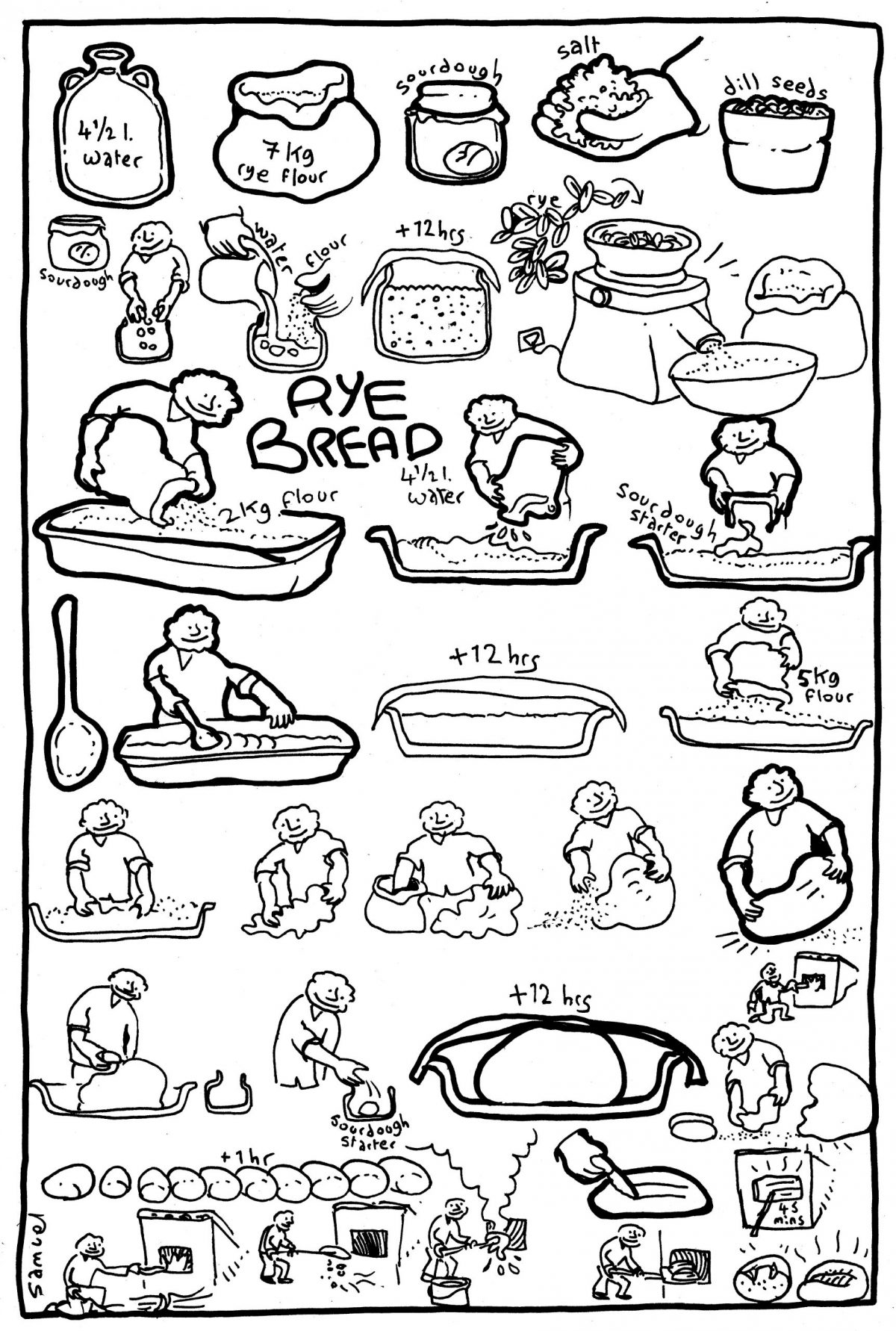
After a certain amount of trial and error, we have found rye, baked into loaves, to be the most reliable staple food that we can produce from our own garden. We also grow buckwheat, for pancakes, and wheat, for pizzas and flat breads, but neither has consistently produced as good a crop as rye. (Potatoes, in theory, could be a staple food, but there is always a risk of a crop failure if one does not use chemicals to control pests and diseases.)
We have built an oven using firebricks on the inside; an alternative would have been to dismantle and reassemble a disused oven, of which there are many in the surrounding countryside, made of specially-shaped stones. We make a sourdough bread, and heat the oven with faggot wood, cut in the winter.
The type of bread traditionally eaten in any particular area is an indicator of the social and political system that people have been living under. The presence of small ovens in every hamlet in our area testifies to a de-centralised network of independent farms; areas where flat breads were the staple food similarly indicates a society in which people had time to prepare and bake their own food every day. Places with a tradition of large ovens and professional bakers suggest a more centralised social and political structure, in which people at the lower end of the social scale had less control over their daily diet. What this says about the products on the supermarket shelves, one has to decide for oneself.
Gareth Lewis