|
I have grown turnips on and off for many years, but it was only three years ago that they became a regular fixture in our vegetable garden – after we discovered the recipe for turnip pickle.
For the gardener, turnip has many advantages: they are easier to grow than many other members of the cabbage family; they will yield a crop from a late sowing; and they are more resistant to pests and diseases than many other plants that one tries to grow in the garden.
Turnips are believed to have originated in central Asia, and to have been cultivated there for many thousands of years. They were one of the vegetables available to the Ancient Romans, and Ancient Greeks, and are grown widely across the Middle East.
They are considered to be a biennial plant – producing the turnip during the first year of growth, and flowering in the second – but spring plantings can flower in the first year if the plants become stressed, resulting in the loss of the crop.
We plant our turnips at the end of July, in ground vacated by other crops, such as onions or potatoes, and they are ready for harvesting around now. We direct sow in ground that has been lightly hoed, and raked. This year, we had a drought, with little or no rain from the beginning of June to the end of September. The ground was dry and dusty, so we poured water into the seed drill before sowing. The turnip seeds germinated within a few days, and the plants then grew without having to be watered again. This is typical of turnips; they are more resilient than most other vegetables – presumably because they were evolved to grow in harsh, Siberian conditions – and it is not surprising that they are a favourite amongst gardeners. This has, perhaps, led some people to make slightly extravagant claims about how good turnips are to eat, and how they can be used in all sorts of dishes – boiled, mashed, roasted, etc. The truth is, however, that they have rarely found favour with Western consumers in modern times, and that in Western Europe they came to be regarded as a food of the rural poor. Turnips were grown by the early settlers in North America, before they learnt how to grow cereals in their new home, and then became associated with the Southern plantations, where they were grown to provide food for people forced to work on them as slaves.
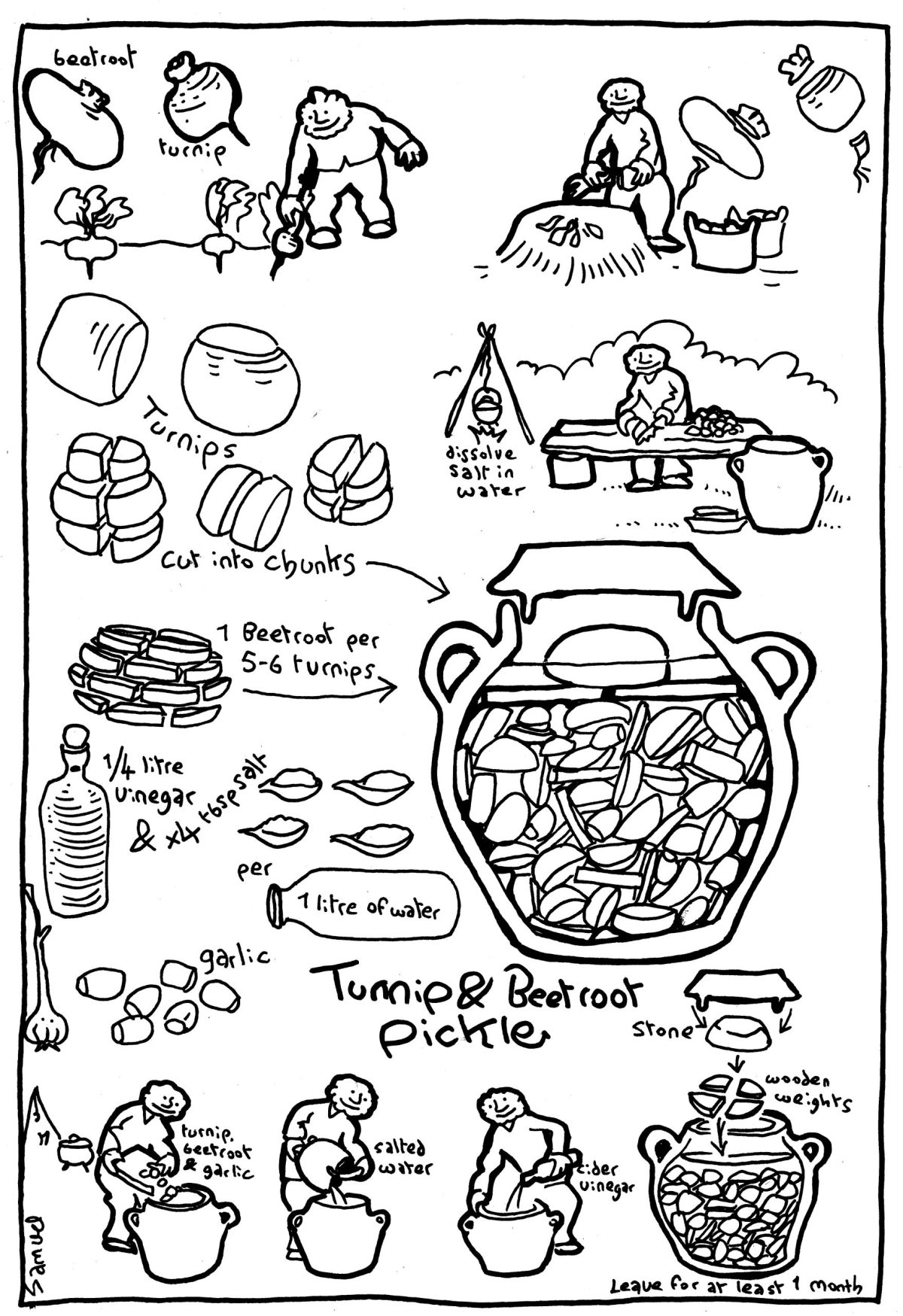
The picture is quite different in the Middle East, where turnips are widely grown as the main ingredient of the highly-valued turnip pickles that are popular throughout the region. The pickle is easy to make, requiring six basic ingredients: turnips, a beetroot (to give the turnip colour), vinegar, salt (non-iodised), water (non-chlorinated), and garlic (optional). The turnip and beetroot are cut into chunks, packed in a jar, and covered in a mixture of brine and vinegar. The jar is sealed with a lid, and the vegetables slowly ferment. It may take a little trial and error before you get the right jars, which allow gas to escape without letting air enter, but once you know what you are doing, the whole crop can be processed quite quickly, and you will have enough turnip pickle to last the winter.
Gareth Lewis |