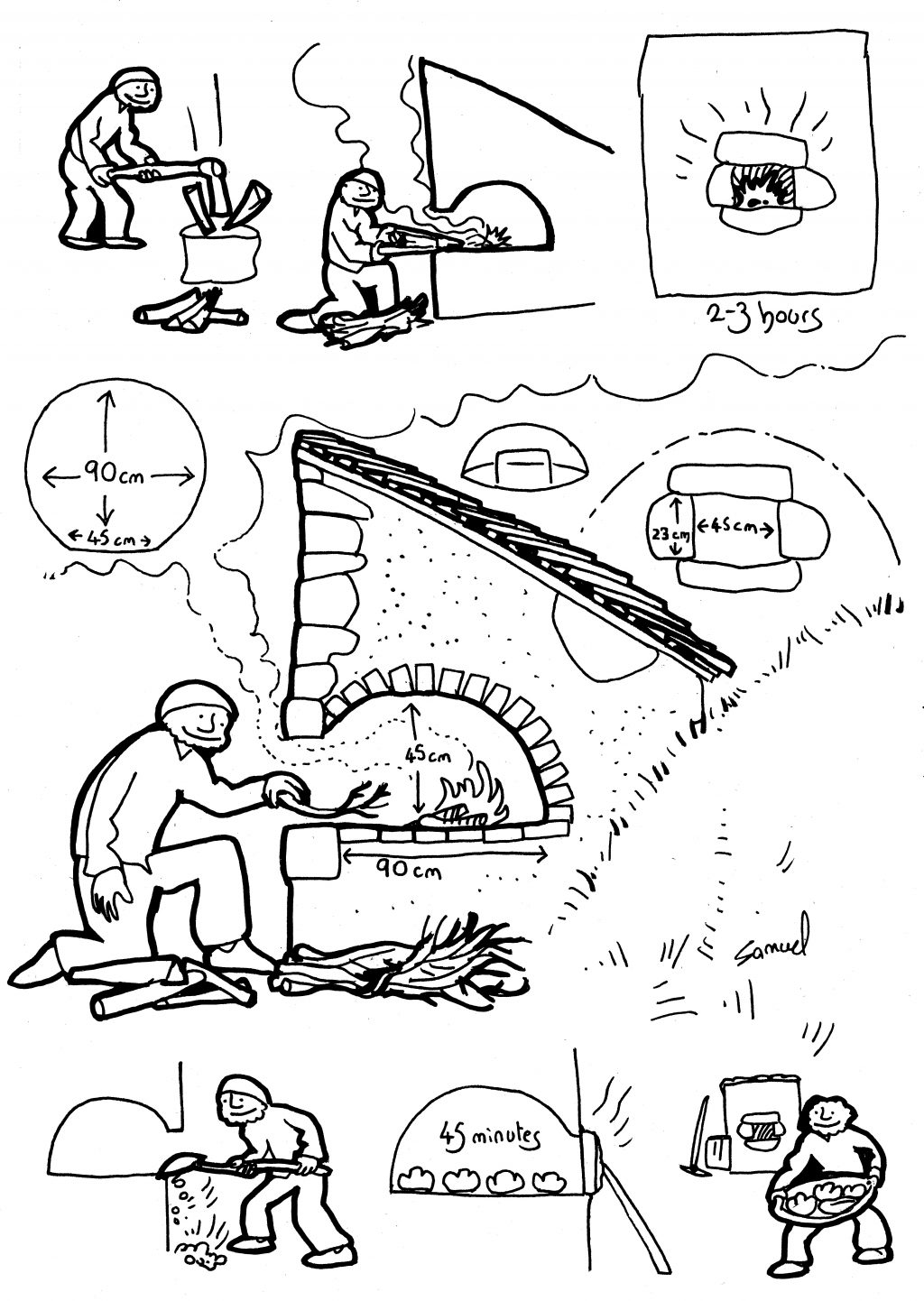
In our part of the world (Brittany, France), outdoor bread ovens were an everyday part of life until well after the second world war. As a result, their remains, in various states of disrepair, are still visible in many places, and it is relatively easy to develop an idea of how they worked.
Ovens in small towns and villages tended to be larger, and quite complicated, presumably because they were used by specialist bakers, who were baking bread for large numbers of people. In the countryside, the ovens are smaller, and built to a simple design that one can copy without too much difficulty.
The basic principle of a simple bread oven is that you create an enclosed space, with only one entrance, in which you can burn a fire. When this oven is hot enough, you rake out the embers, put in the loaves of bread dough, and seal the entrance. The heat is trapped in the oven, and the bread cooks. The door is then opened, and the bread taken out; the oven is still warm and can be used for various things like drying fruit or grain.
Building the Oven
Following advice from friends and neighbours, our current oven is a hemisphere, 90cm (3 feet) across, and 45cm (1½ ft) high in the centre. The old ovens in our area are made of granite stones, cut to shape, but we did not have any of these available, and, instead, opted to use fire bricks. We decided to build the oven into a bank, as that seems to have been a common technique; so we made a flat area, at about waist height, by digging into the bank, and fronted it with a wall made of stones (we have a lot of stones on our property that have been used in buildings over the years). We then laid the base of the oven, taking care to make it as flat as possible.
We then made a mould of the oven on the base, using wet sand, and built the fire bricks up around it, filling in the spaces between the bricks with clay (we are lucky in this respect, as we have clay soil). The entrance was probably the trickiest element; we wanted it to be 45cm (1½ ft) wide by 23cm (9 inches) high. We found stones to build up the front wall with an opening of that size, and wedged in firebricks to fill the space between the stones and the oven. We then covered the whole with a thick layer of clay, before piling earth on top to bring it back up to the level of the bank. Later, we added a slate roof to stop the oven from getting saturated during the winter months – the oven has to be dry in order to reach the required temperature for baking.
Once finished, the sand could be scraped out, and thanks to the miraculous properties of domes, everything stayed in place, despite our relative inexperience.
Firing the Oven
We mainly use faggots to fire our oven – the faggots are made from the brushwood that one gets when trimming and chopping trees in the winter. They are stacked up to dry over the course of the summer. One or two of our faggots, and a few split logs is usually enough for a firing.
The fire is lit in the entrance of the oven, and gradually pushed back as it takes hold; when it is working properly, a current of air is established, with cold air being sucked in at the bottom of the entrance, and hot air leaving at the top. The wood needs to be completely dry.
At first, soot is deposited on the inside of the oven, but as the temperature rises this is burnt off; when the bricks are white (or soot free) the oven is ready. The ashes are raked out, the floor of the oven wiped with a wet cloth, and the bread inserted.
We use a big block of wood to close the entrance, and seal the gaps round the edge with clay; this is a cheaper solution than a metal door, and probably more effective at keeping in the heat. Our oven is large enough for twelve loaves.
If you are starting from scratch, there is inevitably a lot of trial and error involved. Our current oven is our third attempt; but we have now been using it successfully for several years.
Any area that has a tradition of baking leavened bread will also have a tradition of outdoor bread ovens. Copying the local design and building it with similar materials to those used in the past, maximises the chance of success.
Gareth Lewis