In many respects, potatoes provide the ideal introduction to food growing, particularly for anyone who has little or no gardening experience – the plants are strong enough to compete with weeds, they will grow in ground that has not been particularly well prepared, and, perhaps most significantly, they can yield a significant crop from a small area, giving you an idea of what it might really feel like to grow most (or all) of your own food – however, this does not negate the fact that potatoes are a complex crop, and that success is never guaranteed.
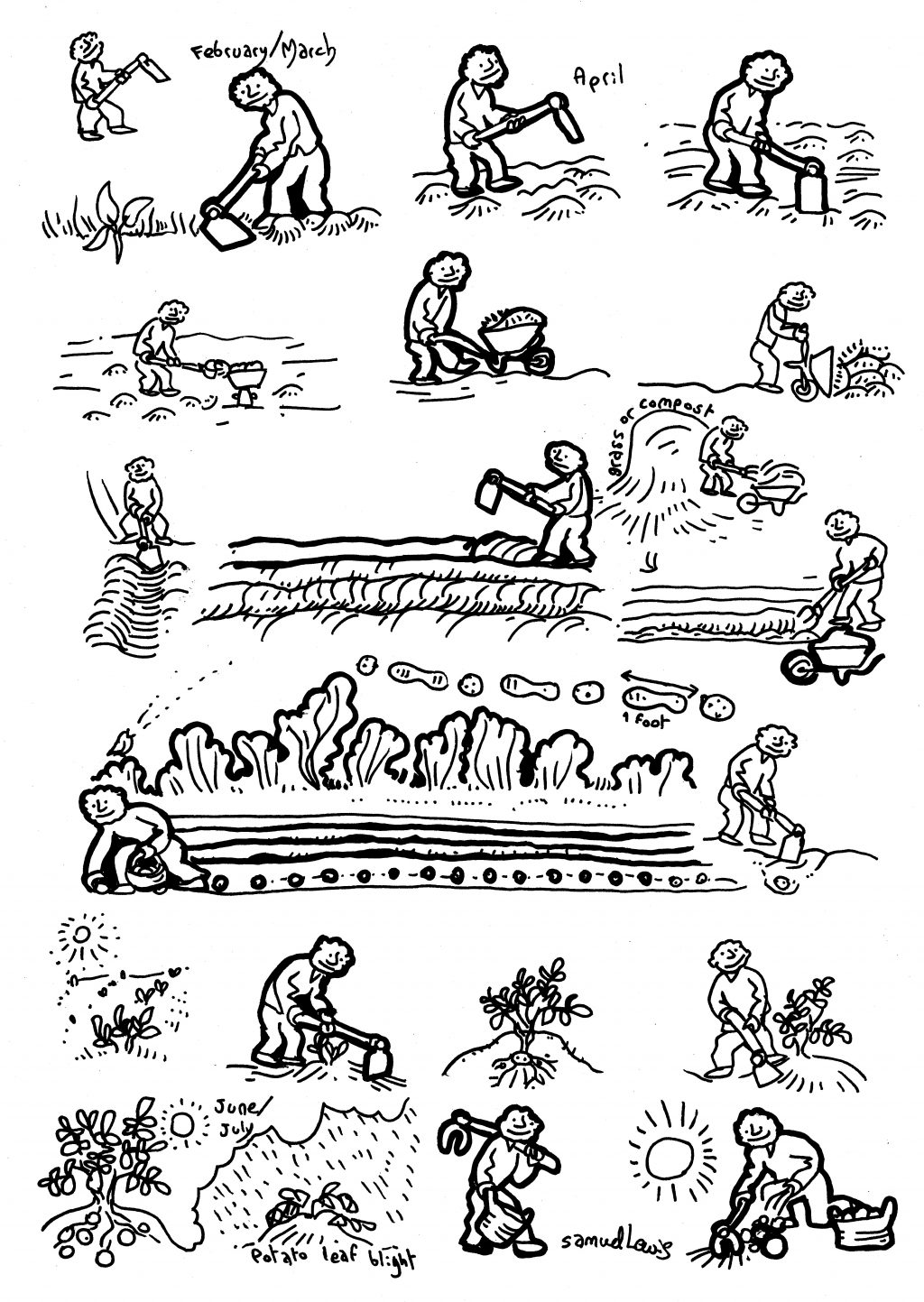
I have been growing potatoes, on and off, for fifty years, in a variety of different locations, first in the UK, and then in France. For the past thirty years, we have been growing them here in Brittany, rotating them round our garden and our small crop fields, but at this time of year I still feel like a novice, trying to decide when to plant, how to prepare the seed, and how best to prepare the ground. We have a long-term commitment to not using any chemical treatments, and this has made me fully aware that potatoes are not as well adapted to our climate as other more-long-established crops that play a similar role in the diet, such as cereals. In particular, in Brittany, potato plants are attacked by a leaf-blight fungus more or less every year at some point over the summer months. If the plants are not treated with a powerful fungicide (as most commercially-grown potatoes are) all the leaves die, the stems turn black, and, whilst the tubers are not affected, growth is finished for the year. This means that you have to time the planting so as to give the plants time to grow, and to produce tubers, before the blight arrives. This in itself is a challenge, as the first signs of blight can appear at any time from the beginning of June to the end of July – but the situation is made even more complicated by the frost. Potatoes, and particularly the young leaves when they first come out of the ground, are frost-sensitive. Even a slight frost in the spring can kill emerging leaves, and set the growth of the plant back by several weeks. Where we live, it is fairly common to have frosts in April, and not really unusual to have the last frost in the middle of May. Given that it takes a few weeks between planting and the first leaves appearing above ground, if one was thinking only of frost, one would therefore plant one’s potatoes at the end of April – but if the blight then appeared in June, the plants would not have had time to make reasonably-sized tubers, and the crop would be negligible. So, in effect, you either have to plant early in the hope that there will be no late frosts, or plant late in the hope that blight will not appear until late in the season.
Chitting
A further complication comes from the fact that, depending on how you store your seed potatoes, they will come out of their winter dormancy, and start to sprout, at different times. If the tubers are being stored in a warm, dark space, these sprouts will grow rapidly in search of light, and will deplete the resources of the tuber; it is therefore customary to lay seed potatoes out in trays, beside a window. This allows the potatoes to start forming green buds, that are robust enough not to be damaged when the tubers are planted; this is known as ‘chitting’. Tubers that have been chitted will grow faster, and emerge above ground sooner, than tubers that have been kept dormant; this has to be taken into account when considering planting times and frost.
It is easy to understand why farmers had a strong resistance to growing potatoes when they were first brought over to Europe from South America in the 1500s. It seems that their eventual adoption was linked to industrialisation, with potatoes first being widely-grown in some places in the late 1700s and early 1800s, and much later in regions that remained purely agricultural. They were a food that land owners could produce in large quantities, and which could be used to supplement the diets of factory workers, and agricultural labourers.
It remains to be seen whether potatoes will retain their current popularity when more people return to growing their own food again, but for the time being they provide an ideal introduction to the practical realities of agriculture. Farming has always involved growing crops slightly outside their natural geographic range, and has always required giving crop plants special care and attention, and if you can manage to negotiate the various pitfalls of potato growing without having recourse to chemical aids, you will be well prepared to tackle other crops which may appear to be more intimidating, such as cereals or beans.
Gareth Lewis
I grow ‘Sarpo Mira’ potatoes here in east Ain (we’re at 550m altitude, with Grand Colombier with snow on its top at the moment, some kilometers to our east). Each year I plant around 40-50 tubers, sufficient for our needs and for next years seed. I have done this for about 13 years and have so far never had blight. I chose ‘Sarpo Mira’ because the advertisements said it was resistant to blight and so it seems to be, here in my garden so far. Is there some reason you do not use this variety?