June 5th 2016
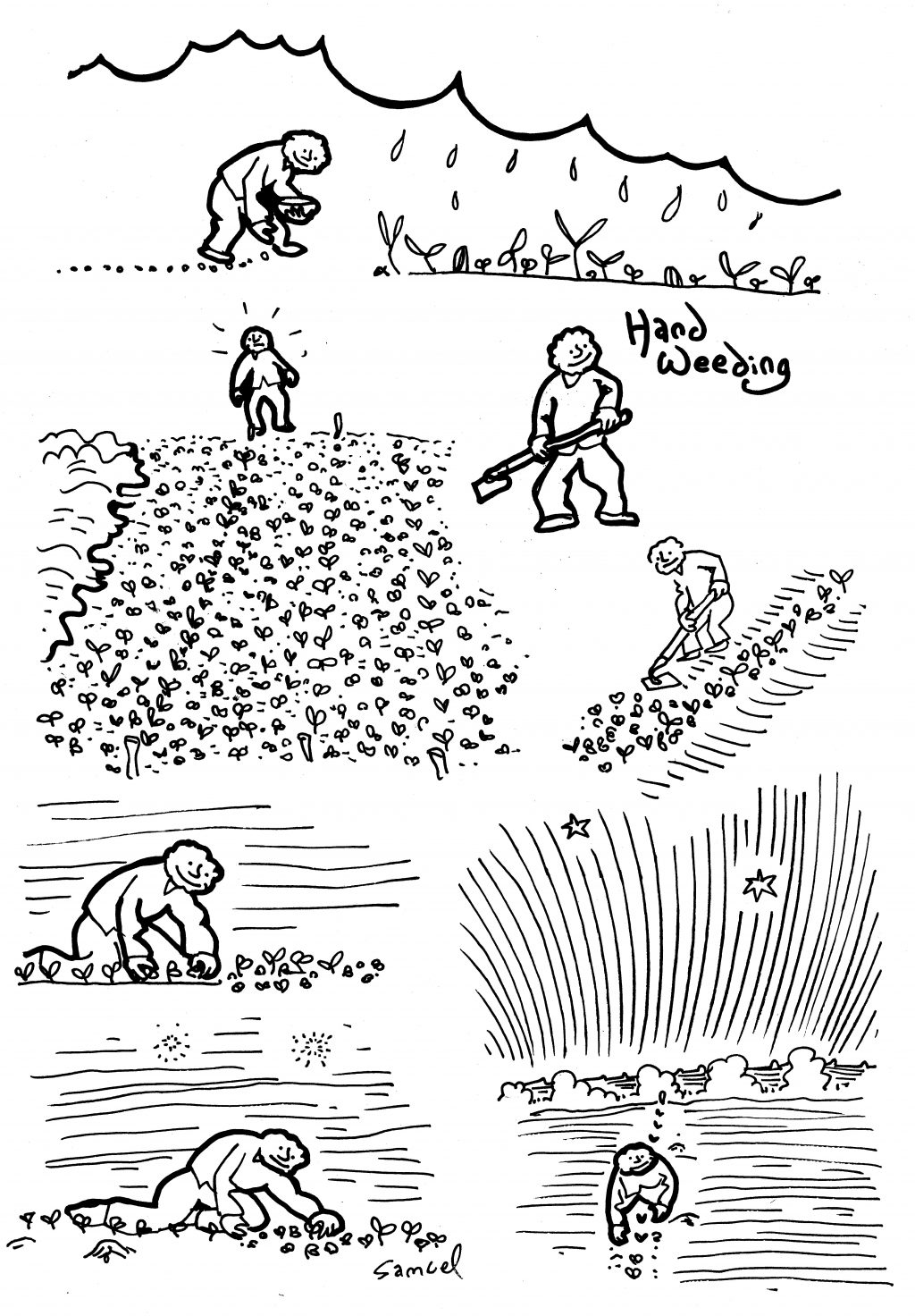
A lot of people try growing at least some of their own food at some point during their lives, but become discouraged after just one or two years, often because they did not realise how much work it would take to control the weeds.
In some ways, however, the presence of weeds is to be welcomed – it is a sign that wild plants consider conditions in your garden favourable for growth. Furthermore, although weeds represent work for the gardener, they are not actually a problem in the way that they are for commercial growers. Weeding the vegetable garden could be seen as one of the joys of gardening, giving one a chance to engage directly with one’s crop plants on a regular basis. The subsistence gardener can afford to spend time hand-weeding because they are only growing food for one household. In contrast, commercial farmers have to grow enough food to feed dozens of households, meaning that they do not have time to hand-weed their crops, and have to resort to less subtle methods, including the use of herbicides. Glyphosate, in particular, is much more widely used than people like to acknowledge, and it is probable that the farming industry would not be able to feed the current world population without it. The long-term consequences of using chemicals to kill plants on such a large scale are not known, but common sense would suggest that they are likely to be catastrophic, providing a powerful argument in favour of finding a more sensible way of farming.
Traditionally, people have had to find a way of dealing with two main sorts of weeds – annual and perennial. Perennial plants are those that live from one year to the next by storing enough nutrients in their root systems to be able to survive the winter and re-grow in the spring. Various types of grass are the most common type of perennial weed. They are relatively easy to eradicate from a plot of land with a little forward planning. If an area of fallow ground is covered with a thick layer of mulch in the autumn, the vegetation underneath will be more or less suffocated over the winter. The mulch can then be removed, and the ground hoed; this exposes the surviving roots to the elements. The ground can be hoed again a few weeks later, further disrupting any root regeneration. Potatoes can then be planted, or the ground can be hoed a third time, prior to sowing a crop such as buckwheat or beans, which will grow quickly and shade out any residual growth from root fragments that may have survived the hoeing. If the area is then hoed and mulched each year, perennial weeds find it hard to become re-established
Annual plants are those that put all their resources into seed production at the end of the growing season. They have a similar life cycle to the cultivated crops, and if you grow the same crops in the same place each year, these weeds become more and more numerous. Some of them are quite benign – no one ever seemed to mind having poppies or cornflowers in their cereal fields, for example – but others, such as bindweed and vetch, can swamp your plants and reduce the yield to almost zero. Annual weeds are controlled by hoeing between the rows, hand-weeding, mulching, and crop rotation. If they become too much of a problem, the area can be allowed to lie fallow for a few years: grasses, and other perennial meadow plants, will soon choke out the annual weeds, and then the cycle can be restarted.
A new type of weed problem might occur if you are taking over some land that has been intensively farmed. Modern methods of both crop cultivation and animal grazing favour the development of weeds that are resistant to herbicides, and which can survive deep ploughing. These sorts of plants should disappear over the course of time in a well-managed subsistence garden.
The vegetable garden will always require more work than the cereal fields, because it will be sited on the best bit of land, and there is little incentive to let it lie fallow. Weeds are controlled by mulching, hoeing, and a lot of hand-weeding.
In a subsistence garden, the weed-control programme can be tailored to each individual small plot of land. Different soil conditions favour different weeds, and, over time, you get a feeling for which weeds grow where, and when it is the best time to plant and to hoe each crop. This micro-management is not possible for large-scale farmers, and provides a powerful argument in favour of a return to a small-scale farming system in which everyone is responsible for growing their own food on their own land.
Subscribe to the Newsletter: