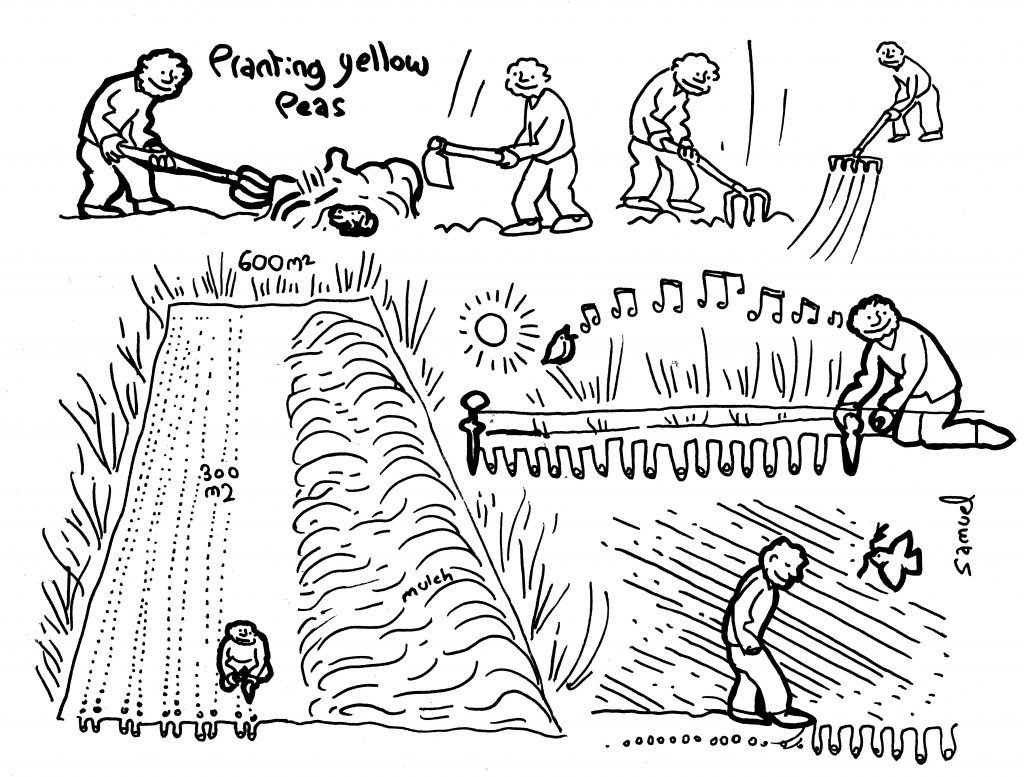
We have been growing yellow split peas here in Brittany for several years now. We started with a single row in the vegetable garden, and have gradually increased from there; this year, we have just finished sowing half of one of our small fields (about 300 square metres) with yellow peas.
The main reason why we grow them is because they are popular in the kitchen; they can be used to make soups, Indian-style dals, and traditional pease pudding.
They also fit in well with our crop rotation; they are a legume, and their root nodules therefore help to replenish nitrogen levels in the soil. If we plant one half of a fields with peas, and the other half with beans, in a good year, we have more than enough of each crop to meet our needs.
Given these advantages, it is perhaps strange that more gardeners do not grow yellow peas. Most of the literature on yellow split peas – or field peas as they are known in North America – relates to commercial farming, where they are grown on an industrial scale; although there are some points in common between gardening and large-scale farming – such as planting times – there are also differences. Gardeners can be put off by having to dry the peas; we live in a damp climate, and even in summer, when the peas are ripe, we can have prolonged periods of rain, and the peas start to germinate if the plants fall over and make contact with the ground. We surround our double rows of peas with bamboo fences (we have a lot of bamboo), to stop them from blowing over in the wind; when the peas are ripe, we pull up the plants, tie them in bundles, and hang them up in an open-sided shed. When the pods are crisp and dry, we thresh the plants, sieve out the peas, and winnow them to remove bits of stem and leaf.
Another problem for some people may be the splitting. As far as I can tell, the peas can be cooked and eaten whole, but they are traditionally split. Splitting helps in the storage as it deters weevils, and it also allows the pea skins to be winnowed and sieved out. We have a stone mill, which does the job well, but we have also used a metal mill, and an electric flour mill.
Given the scarcity of advice available, split pea growing inevitably involves a lot of trial and error; we plant in March, one or two months before the last frost. One year, a blackbird systematically pulled up all the seedlings as they appeared, and ate the pea, so we now dib each seed a few inches into the ground – the theory being that the nutrient reserves in the pea are exhausted by the time that the seedling emerges above the surface. Another year, the pigeons seemed to be exceptionally hungry and pecked the young seedlings to the ground, effectively killing them. Our bamboo fences are designed to deter the pigeons, at least to a certain extent.
Gareth Lewis
Your soil management is very impressive. I wish you sunshine and enough rain for your cultivation.
Here in Québec, Canada, nobody is cultivating anything as the ground is still frozen… However, the maple trees are putting up their sap, so spring is definitely on its way.